Way to Compost 1: The Backyard Food Digester

For gardens and people in the city, room and time are big obstacles to composting.  A food digester, sometimes known as a green cone, is perfect if you want to keep organic matter out of your garbage but not work too hard, take up too much space, or think too much about composting it.  Basically, it’s like building a stomach in your backyard that will digest all your leftover food.

Here’s how to do it.  Find an old plastic trash can, or buy a cheap one at the hardware store.  Drill holes all over the bottom and about two feet up the side all the way around for drainage, aeration, and to let the worms in and out. Then, dig a hole so that at least a quarter of the can is in the ground in a shaded, well-hidden place.  This is the only hard labor required.  Put a layer of leaves or small twigs in the bottom of the can.  This is the first layer of your compost “cake.”  From here on out it will go like this:  kitchen scraps, browns (leaves, a little soil, old grass clippings), kitchen scraps, browns, and so on until it is full.

Here’s how the digester system works from kitchen to compost.  Keep a gallon sized, lidded container under the sink to scrape food scraps and vegetable peelings into.  It can be plastic or stainless steel.  Don’t be afraid to put in uneaten mac and cheese, soup, bread, rice, tacos, Fritos—anything you didn’t eat.  And don’t forget that all paper towels, napkins, tea bags, coffee grounds and filters, paper plates, the tubes inside of toilet paper, and newspaper can go in, too.  Carbon sources like these help keep odors at bay (carbon is a great filter) and worms very happy.

Make a trip to the compost container once a week to dump your lidded container.  Be sure to cover it brown stuff—soil, grass clippings, or straw.  You can keep a pile of these brown materials right next to the digester.  I suggest putting on an “inner” lid of pine branches or even a pizza container as well as the trash can lid.  This keeps down smells and reduces fruit flies.  The outer lid should be secured with a bungee cord so little critters like raccoons and rats don’t help themselves.

That’s it!  In about a year with no turning or thinking, the bottom of your bin will be rich compost ready to put around plants in a small garden.  Two digesters side by side is another good idea.  When compost is harvested from the bottom of the first one, the partly digested top material can be shoveled into the bottom of the second one and the process starts over.  Or, you can fill up the first and wait for it all to compost while filling up the second one.

Of course, there will be some troubleshooting.

  1. If the material becomes too dry, it won’t decompose. Be sure to water the digester, especially in the summer, if it is too dry.
  2. Remember to keep a lid on.
  3. Avoid putting meat and dairy in the digester, and bury the food well each time with browns and the inner lid so that maggots and fruit flies will not be a problem. Besides worms, there will be all kinds of bugs in the food digester. It’s a plethora of study material for future entomologists.  Sow bugs, little white springtails, ants, centipedes, beetles, and other kinds of creepy crawlies are harmless and help to break down the organic matter.
  4. If the digester smells (too wet, maybe), mix in soil and carbon sources and it should be better in a couple of days.
  5. You may find vigorous, hybrid varieties of squash and tomato growing where you spread the compost. These seeds persist in this type of composting since there isn’t enough heat to destroy them.

And now for a sneak peak at my backyard food digester, eight years old, quietly working away, mostly forgotten, tucked behind the shed where I hope no one looks. But for you…

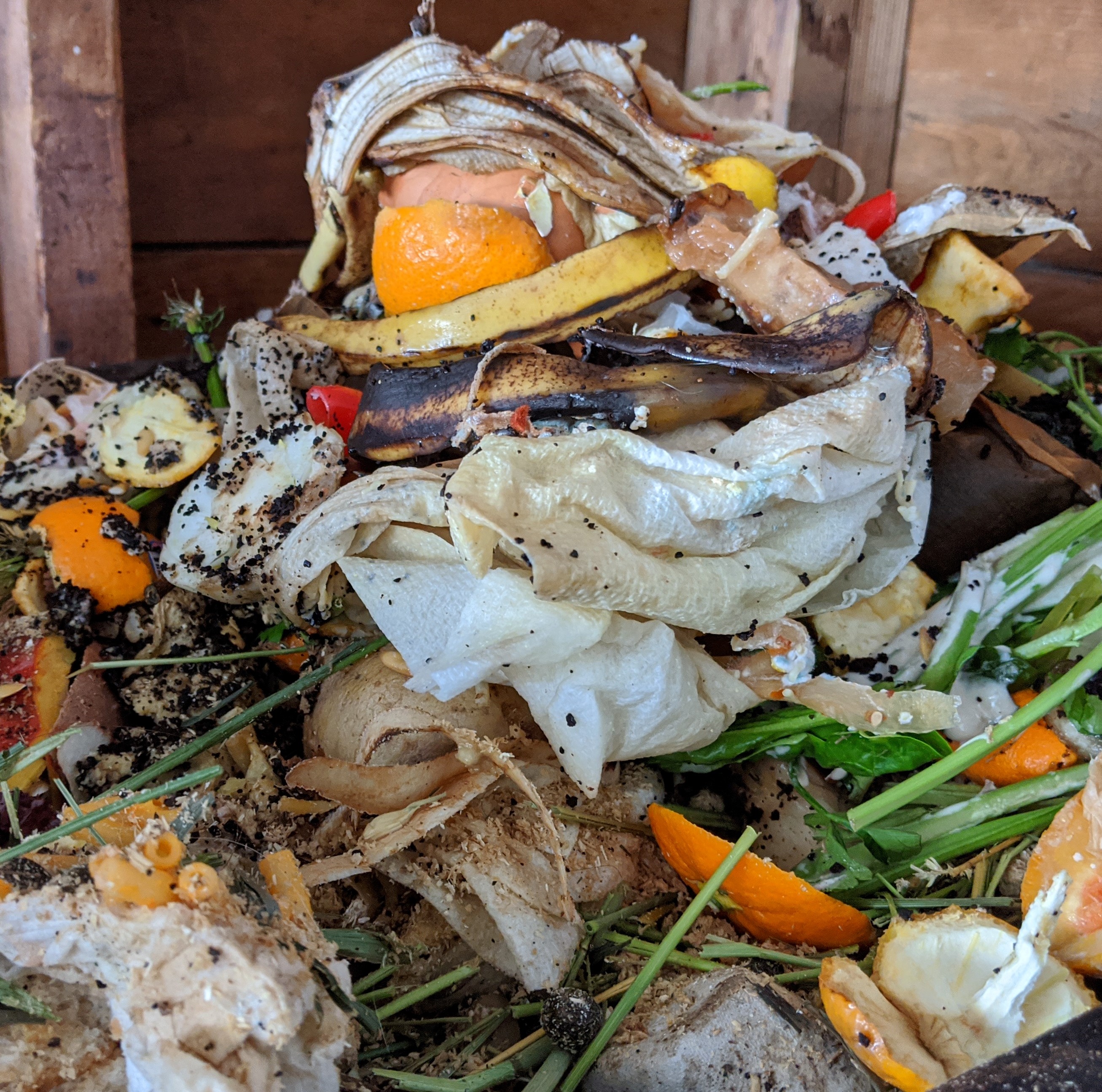
Notice three large pinecones–raccoon latrine deterrents (ouch! works great) and weight for lid…a brick or bungee also works…a pile of leaves to layer after dumping kitchen waste…only pistachio shells and pumpken seeds are recognizable. I never turned it or rolled it, only layered it. About once a year, I shovel the finished compost into my wheelbarrow. Looks like it’s time!

One stomach behind the shed is great, two stomachs would be ideal. One to fill again while the full one digests. Don’t you wish you had two stomachs? Now you can!

Composting back to life

Compost connects leftovers to new life

When anything once alive dies and is put in a compost pile, microscopic life forms begin their work of living and dying. They break down organic matter into tinier and tinier pieces, more elemental with each pass through their microscopic bodies. They eat and live and also die, until all that has died becomes entirely new—a particle of nitrogen or carbon, a trace mineral, a salt—so it can be taken up again into plant roots, into animals and human bodies, into trees, then fall back down to the soil as sticks, leaves, bones, and flesh. We label this up and down rhythm life and death—a beginning and then an end. But death it is not the end with compost, rather it is the beginning of something new. I do not completely understand how the transformation happens. Science can explain the invisible process in books, but I go out to the compost pile on a regular basis to observe and maybe absorb a little of the mystery that gives life to our human and earthly bodies.

There is not just one way to compost. It can be done in many ways, and all of them lead to a rich source of life for the soil. I admit that composting is not always fun, like riding a roller coaster or going to a movie is fun. It is not always easy, like throwing away food is easy. It can be mundane, messy, and sometimes annoying. Composting is a mindful act—a decision to humbly take responsibility for our own waste. I found, once I committed myself to it and carved out the time to care for my own waste, that I had invisible helpers. I created a big pile of smelly, clumpy, sloppy waste, but a mysterious collaboration of earthly life transformed it into sweet smelling, crumbly, richly dark humus—the building block of life in the soil. I also noticed that I was more forgiving of my own “garbage.” My life’s leftovers—the sadness and pain I usually put a lid on and never wanted to deal with—were uncovered, held, observed, and worked into my life with love. I began to feel more whole.

I invite you into the messy, mundane, mysterious, and restorative life of compost.

Michigan smells different…

“Like we’re camping.”

The first positive words that came out of my mouth about our new home in East Lansing, Michigan were olfactory. I sat on the top step of the back deck, our 3-month-old cradled in my arms, back aching after moving quickly and sleeping badly and breastfeeding constantly, and breathed in the spicy, evening scent coming from the exhalation of old trees and the swampy-sandy soil I would soon be completely baffled by when trying to grow anything other than purslane (edible), creeping charlie (I confess I love the smell of it) or sedges (native).

I did not want to be on that step.  

My back to our unfamiliar house, my eyes wandered along the tops of the pine trees concealing the parking lot on the other side of our fence, the human-sized eastern black nightshade and garlic mustard inside the fence and the enormous wild cherry leaning uncomfortably over the fence.

This was not the step I wanted to take.

We had been living in Columbus, OH (Michiganders, stay with me) for 5 years already, and I was ready to move on. True, Columbus had a food scene that satisfied the cravings of two, older-than-30-something graduate students who enjoyed a bite beyond Chipotle. True, our dearest friends lived in Columbus and our two-year-old daughter’s first, dearest playmate: all heartbreak (hearth-break) to step away from.

But if we had to leave, I planned to go west, all the way to the coast where I could stand and spit into the Pacific Ocean on any given day, as my Grandpa would say, or at least a river that ended up there. Somewhere between Oregon and Canada.

Instead, we went roughly 3 degrees North and 2 degrees West from the middle of Ohio to the middle of Michigan.

Columbus, OH:
39.9612 N by 82.9988 degrees W
East Lansing, MI:
​42.7370 N by 84.4839 degrees W

People refer to Michigan as “the mitten.” There’s a reason why they do. You need them. Winters are cold. And long. I’m writing at the end of April and last week we had an inch of snow. No one gets their hopes up above freezing until the middle of May. 

Oh, and Lower Michigan is a mitten-shaped peninsula, a wool-wrapped hand gently patting the frozen waters of the Great Lakes.

Michiganders do that thing where they hold up their hand in the shape of a mitten, fingers together, thumb out, and point to where they live. I swore I would never do that.

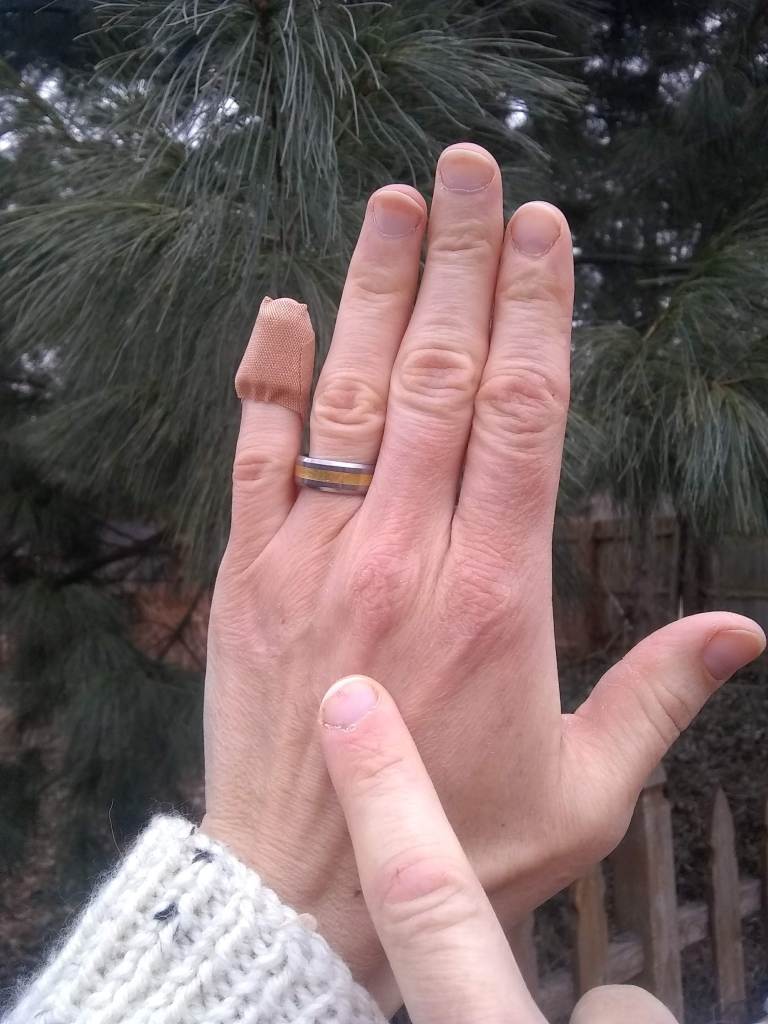
We bought our first home right in the middle of the mitten. Hold out your right hand facing away from you, fingers together, thumb out to the right and put your left pointer finger in the middle of the palm of your left hand. There we are. Dead center. Oops.

When I did the mitten thing for someone the very first time, my thumb, meant to be representing the Blue Water Area of Michigan (think Flint, Detroit, Motown, light houses, St. Clair River flowing into the largest fresh water delta in the world and driving south to Canada) pointed the wrong way. It was sticking itself into Lake Michigan instead of Lake Huron, looking to hitch a ride West (wait, is that right?).

I know, my hand’s backwards

I was inwardly rebellious of the entire lower mitten, not to mention the other one above it.

What’s the big deal with the cherries and the apples? I grew up in Eastern Washington with plenty of apples, cherries, apricots, peaches, pears and grapes. Washintonians also say “pop” instead of “soda” and we never drink either one with something called a Pastie (short “a” sound, not long). Trolls and Yoopers (no comment)? I tried it, and Superman ice cream is gross (Michiganders can throw some at the screen if you like). Can the Great Lakes compare with the Pacific Ocean? Why does everyone casually mention they’re going up North to their cabin for the weekend? What’s up there, and why does everyone have a whole other house, excuse me, cabin? Why can’t I just turn left without being forced to first turn right?! Do I have to love Sparty (my daughter fell in love the minute he mimicked her picking her nose at an MSU baseball game) or the Lions (I grew up loving Seahawks)? Will I need to learn Euchre (my husband’s family plays Pitch, for all you Nebraskans out there) or how to cross country ski?

Not           my            step

I eventually pulled my daughter close, got up from the top step of our deck, went upstairs and opened the bedroom window of our 1948-built home that first night, and almost every night after, because the air smelled good. Even though we lived in the middle of East Lansing in the middle of Michigan in the Midwest, that smell in the air was annoyingly, invitingly, invigorating.

Leave a comment

Notice:

I want to shout enough!

ENOUGH!

About the places that we board and we take and we squander.

The women crying out! Listen to them

The vulnerable, the small, the poor,

We steal their right to be.

To speak is to exist, to take up space, to complete the whole.

Enough!

I want to have a tantrum like a toddler

Scream the hurt and pain that lingers.

Why do those in power get the voice?

Why do those with money get the choice?

The woman who sat with her coffee and her paper

The men with their boots and opinions

The women playing mahjong and bridge

They gather, they talk, they interview, they bring

Their family and sisters and brothers

And developers? They say it’s not enough.

Not enough money.

They say you are not enough!

The love of money is evil, he said, and he was right.

We love it so much we give those who have it the right

To decide

Where buses go, good produce, green parks.

The best streets, the most trees,

The beings we save and the beings we let die.

Enough!

These words aren’t enough!

Why do we act from scarcity?

Why don’t you act scared of me?

I am the woman, the athlete, the mother

I speak for the little, the forgotten,

the soil, the air, the mammals warm and dying,

the children, the teenagers, the elderly.

They are our enough!

Give them food and shelter,

Give them beauty and plenty,

Hell, give them money, yes a minimum standard for everyone

to ease the burden, to lift the weight

So they can fly, their imagination, their ingenuity, their creativity

Their capacity

To love!

To experience this world in all its beauty!

Beauty is enough!

Why do we take land from native people and

native flowers and trees and birds and bears?

There is enough!

Stop reaching, stop taking, stop fighting,

BE STILL

Enough!

Why aren’t the voices speaking for love

Amplified like the fear that we hear in the news

In the news, it is not enough, but here, right here

It is enough.

WE ARE ENOUGH

to turn the tide

To stop the hate and the violence and the unjust, the persecution and damning blindness.

ENOUGH I say to administrations that abuse and use and persecute and squander

The beauty that is the immigrant and the refugee,

And the dream that most Americans have woken from.

Enough! Enough guns for they fail

To make us safe, they replace

The words we need to speak

To hear where we hurt, where we are ignored and forgotten.

Walk into the garden, look at the pain the world is in

put your guns down, dig your hands in, sweat!

It is enough!

What words do I need?

Life is too short

Life is too precious

Life is found in forgotten streets,

in quiet meadows,

in trees growing through sidewalks,

in the apartments shoved out

and all the people who made their home

there stepped on, told to go.

Enough, I say,

ENOUGH!

Are you uncomfortable yet?

Is this Enough?

Your voice belongs here, too. Please,

an invitation to

Tell us your enough

You’re

ENOUGH

“I Dream a World”, a poem based on Langston Hughes’ “I Dream a World”

I dream a world beyond

the walls that keep us in,

the locks, the gates, the bars

all fall away and then

we gaze upon each other,

each life a glorysound,

like birds aloft, aflutter,

our songs, once lost, are found.

A world beyond the grip

of violence, fear, and greed,

where all can breathe the air,

breaths deep and whole and free.

I dream a world alive

with creatures great and small

who have good food to eat,

clean water, beauty, all.

This world we dream to being,

dream light into the dark!

Then gather up the words,

ignite them with love’s spark!

Coffee

Thank you God for coffee

That gets me through the day

That keeps me nice and regular

(Maybe that I shouldn’t say)

‘Cause if it weren’t for coffee

I don’t know what I’d do

I’d probly chew tobacco

‘Course there’s marijuana too.

Nah, I wouldn’t chew tobacco,

But coffee stains my teeth

I think I’d use the hash

Cause I’d have better breathe.

Who am I to say

What’s right or good or bad?

When pushing comes to shoving

It’s whatever people have

Around them when they need it,

A mental shift in mood.

Mine’s black and strong with cream

It’s psychoactive too.

In other places it’s totally fine

To drag on this or that.

Culture is such a blinder

I’d rather just forget

About stigma (gasp), taboo

Who needs them anyway?

Thank you God for coffee

That gets me through the day.

Wasp Spa

Tiny, cobweb width limbs reach quickly forward to rub her mandibles. They move on to stroke the delicate line of her left antennae. She starts quickly near the base where it connects with her ovally head, then slows as she reaches the antennae’s end. A tiny curl at the end of her leg (a foot?) reaches it last, bending it oh so slightly at the end.

She is so precise! Every time it is the same, the same motion, the same meticulous timing.

What is she made of, those tiny parts, able to move and bend so quickly without breaking or turning to dust, then springing back to where they came from? As if there were an invisible frame around her tiny body that is made just for her.

She moves on to cleaning her stomach and braces her lower abdomen with her four other legs. The base of the abdomen comes to a menacing point.

That makes me cringe a bit, that point, but if I just look at the top of her I can watch as she fluffs her antennae without concern. Sometimes she reaches up and rubs it with the crook of her little limb (an elbow?).

She moves on to rub her back as if there is an itch or some tiny particle I can’t see.

It’s been 10 minutes now of meticulous preening in the window of this coffee shop. Maybe, because she can’t get out, she is taking the time to stop and care for her own little body while she watches other insects fly by.

Her wings lift, her abdomen now at a ninety degree angle to the sill, stinger pointing up, so much more menacing than before. She turns one wing with her arm, cleans underneath it, rotates it on an invisible axle.

I am paralyzed as I watch this miniature solo spa. That stinger and those bold black and yellow lines keep me on a cautious watch. What should I do with her? Get a cup and let her out? Leave her here?

Maybe she doesn’t want to return to the outside, those millions of children, the buzzing nest. She saw the wooden doors open and slipped in, following the window’s light to this lacquered sill. It’s quiet here, no birds hovering, no other wasps buzzing, nothing to build, no one to listen to, no expectations. Just this. Time to polish her antennae, shine her sub-wings, rub clean invisible particles.

Who?

Do you remember the film the series “Planet Earth?” New technology allowed them to zoom in from tremendous distances with crystal clear clarity.  Such groundbreaking camera work is not only visually stunning, but scientifically important in studying the behavior of animals while unaware of a human presence.  The series included, “Deserts,” “Ice Worlds,” “Great Plains,” “Caves,” and “Mountains,” but missed one of the largest, most fascinating, and crucial parts of our interconnected planet—the soil.  So, for the next few paragraphs, let’s take a close look at what we walk on every day.

First, “Soils” takes you to view the largest and heaviest living organism in the world.  Not the Pacific Ocean’s Blue Whale or newly discovered Giant Squid, but Eastern Oregon’s honey mushroom.  The fungus Armillaria has been growing in the Blue Mountains for over 2,400 years.  The mushrooms above ground are only the fruiting bodies of this giant.  Below ground, its white filaments, or mycelia, spread over 2,000 acres, penetrating the roots of trees and siphoning off water and carbohydrates.

In this same forest, a rare, slow motion shot captures the dramatic flight of a springtail. The almost transparent arthropod uses its well-developed mandible to graze on fungus at the base of a tree.  Suddenly, its arch-enemy approaches—a small ant with a strange, spongy structure between its thorax and abdomen that emits an irresistible odor.  Stinger ready, the ant moves closer, but the springtail comes to its senses just in time.  It releases a catapulting organ tucked under its abdomen and springs twenty times its own length to safety.

The camera follows the baffled ant as it scurries down into the leaf litter.  It is a quiet, moonlit night, and the soil surface comes alive. A night crawler waves a third of its body above the ground in an eery, graceful dance.  It finds a leaf and pulls it down into a vertical burrow lined with its own mucous.

Not too far away is a colony of several million ants.  These particular ants practice aphid husbandry.  They faithfully transport aphid eggs to their nests each autumn, tend them in safety, then take the newly hatched aphids to fresh, spring roots.  As a reward, adult aphids leave their sugary droppings, called honeydew, as food for the ants.

Finally, “Soils” films the strange and captivating Tardigrade, or “Water Bear.”*  Just as the Polar Bear elicits “oohs” and “aahs” with its antics on the ice, so the tiny Water Bear, only 1/50 of an inch long, is the charmer of soil critters. They come in red, green, orange, yellow, and pink, and their eight legs each end in four tiny claws.  Their eggs, spheres decorated with geometrically patterned spines, knobs, and ridges, are fascinating and beautiful.  If the humidity level in their microscopic habitat drops, they shrink like a dry sponge into an unrecognizable form. In this state, they can survive temperatures up to the boiling point and down to -200 degrees F.  Then, even after 120 years, the dehydrated Tardigrade can be brought back to life.  Some scientists are studying this amazing feat of cryptobiosis (hidden life) to see if humans could do the same.

Here’s one of the coolest videos I’ve ever seen on tardigrades!

And this is just the beginning.  There are thousands of animals and insects that live in symbiosis and competition under the soil—from Ant Lions to Glowworms, from Camel Crickets to Kangaroo Rats.  Without them, life above the soil would come to a messy halt.   Soil creatures take the minerals and nutrients that drop to the ground from above and incorporate them into the earth’s skin where they resurface as new plant and animal life.

In order to better understand the soil and critters that inhabit the soil, all you have to do is build a compost pile and observe it closely.  Ants, springtails, worms, beetles, and maybe even a Tardigrade will appear to transform your detritus. If you would like to see pictures of all of these creatures, check out the book “The World Beneath Our Feet: A Guide to Life in the Soil” by James B. Nardi, and watch the movie, “Microcosms,” a documentary set to classical music depicting the wonder filled life of insects.

*The drawing of the water bear for this post is from the DataBase Center for Life Science (DBCLS) – https://doi.org/10.7875/togopic.2017.5, CC BY 4.0, https://commons.wikimedia.org/w/index.php?curid=57116616.

Jacques and Sylvia

I’m sure they had their bad days
Mornings the coffee was no good, the ship off course.
Days people didn’t even care that they dove
down, down, into places hardly any other human has seen.
Quietly flying through the sea.

Mysterious and utterly enchanting.

Only to surface to gravity pressing on them, waves slapping at them.
Heaving equipment onto the deck, peeling wet suits off their bodies and trying
to describe heartbreaking beauty to land lubbers.
Falling in love so deeply they couldn’t stop.

Wailing love letters from the ocean like sirens.

And like sailors who can’t be bothered to stop,
we close our ears and refuse to listen.
Sylvia! Name like a silver fish!
And Jacques! An ocean of secrets!

Human, like you and me, in love with the sea.

In love with maternal whales, grumpy groupers, ruthless sharks,
eels, corals, currents and caves.
They dove into the dark and were enlightened.
Sylvia, Jacques, speak to us!
Cry out from the depths of our own sea souls
until we let the water carry us back to ourselves.

Crazy

I thought I might take my ukulele outside
and sing to the compost pile after it was made.
Maybe crazy,
but so was Mozart
and Patch Adams
and the man who plays his guitar
on the median of
East Michigan Avenue and Howard Street.
I think I know
that playing Bach’s Cello Suite #1 to cattle
just before slaughter
feels a little crazy
but is the sanest thing to do under the circumstances.
When I was young,
crazy was awkward
and we may never get past
the way we think we look to others.
But at 40 I finally know that to sing to compost piles
wear a wig while composing music
or a clown nose while treating patients
and bring Bach to beef cattle
and play a guitar on the median
makes beautiful sense.