Why Compost?

Let’s talk about compost—what it is and why we need to make it happen now more than ever. Every time we eat plants or animals who eat plants, the nutrients they and we need to grow are taken from the soil and put into our bodies for energy. We burn it as energy, but there are always leftovers. Up to 40% of the food grown in the United States is wasted. If these leftovers are not returned to the soil to be recycled, then the cycles that sustain life are broken and things start to get messy.

You’ve probably heard this before, but it’s worth repeating. A handful of compost contains more living organisms than there are people on earth! Our eyes cannot see it, but compost is dynamically alive! The nutrients, minerals, bacteria, fungus, and other microscopic life forms found in compost are vital for healthy soil.

In the United States, we use soil 10 times faster than the natural rate of replenishment, and we only have about 60 years of topsoil left in the world. Such an estimate has to give us pause, and a dose of healthy concern. We need compost in all its forms—backyard piles, turned under cover crops, worm bins, municipal compost operations, forest floors, manure left in the field or composted in the barn, compost toilets (yes, human compost)—and every other way we can think of. We need to balance our soil withdrawals with compost deposits.

This can happen in your own backyard, in a church kitchen, in a community garden, in a garage, and even in an apartment. I’ll discuss how to make compost piles unique to your life style a bit later, but for now I’ll sum up what makes composting work no matter what form it takes. There are 5 keys to creating a healthy compost pile—carbon, nitrogen, water, air, and mass.

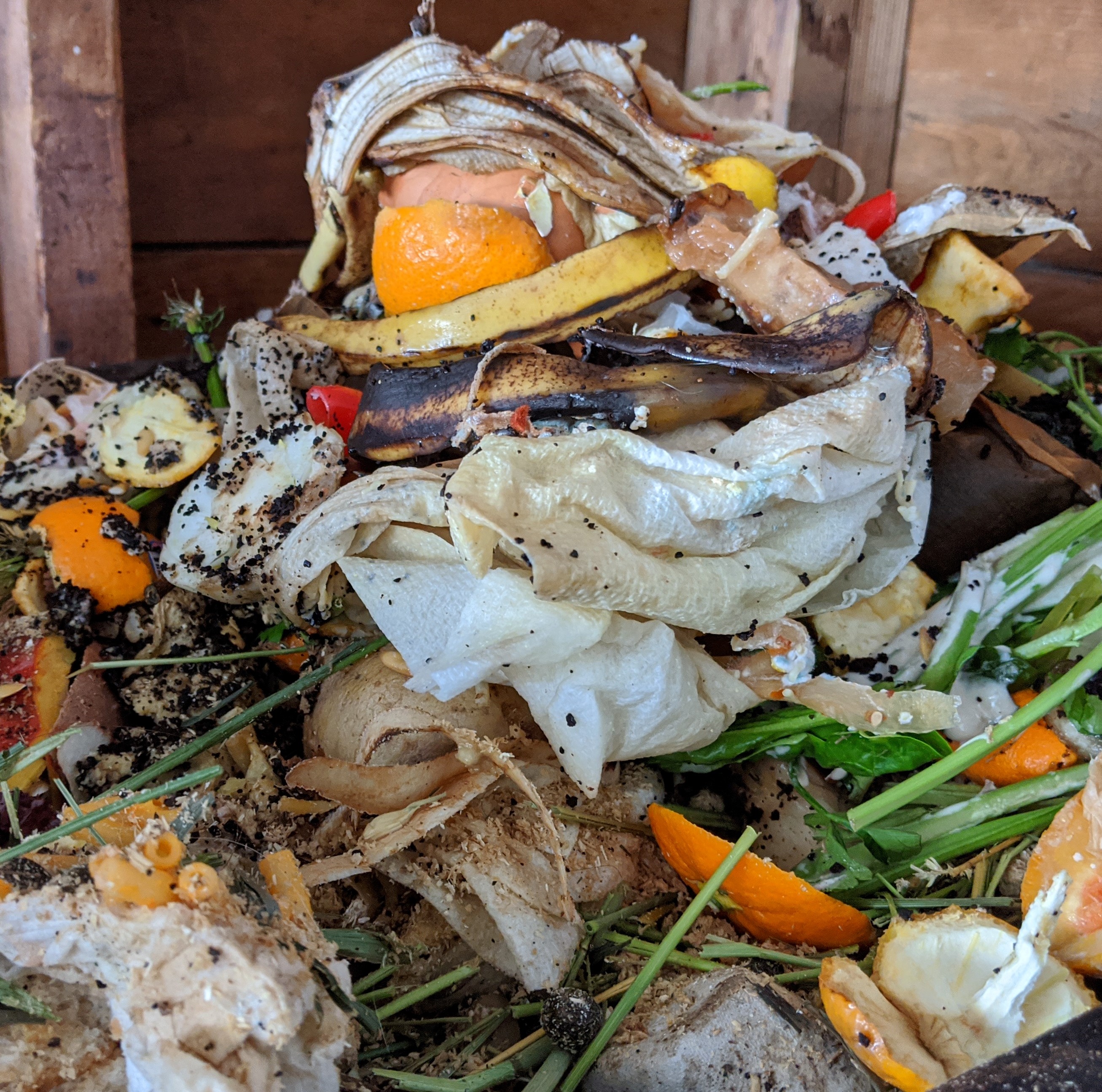
1. Carbon and nitrogen are the main ingredients of compost. Vibrant compost piles need a ratio of 20-35 parts carbon to 1 part nitrogen. Carbon, the “brown” materials, are usually brown and dry. Bags of fallen leaves, newspaper, cardboard boxes, paper towels and napkins, wood chips, straw, brown grass clippings, and the morning croissant are all examples of carbon. These are what the compost microorganisms need for sustained energy. Smaller pieces of brown material will break down more quickly because there is more surface area for the microorganisms to work on. Chipping wood or mowing leaves helps to speed up the composting process.

2. Nitrogen, the “green” materials, are usually green and wet. Fresh grass clippings, kitchen scraps, manure of all kinds, coffee grounds, and nutrients like blood and bone meal are all good sources of nitrogen. These will be used by the microorganisms to build their microscopic bodies.

3. A compost pile should be as wet as a wrung out sponge. In order to move, breathe, and function, the microorganisms doing all the work need this water.

4. The microorganisms that break down organic matter also need oxygen. You can compost without oxygen, but it’s smellier. This is called anaerobic composting (more on that later). Making sure the pile has plenty of brown, carbon material to create pockets of air will ensure it has enough oxygen. The pile should be a bit fluffy, like a compost soufflé. As it breaks down, the cake will flatten and reduce in size. This is a good sign.

5. The last key is mass. If it’s not big enough, the compost pile will not be active. A 3’ by 3’ pile is the minimum size for decomposition to really start. But piles built outside need to be at least knee high and wide. You can put your pile inside chicken wire, straw bales, re-used pallets, or even a cheap garbage can buried a foot in the ground with holes drilled into the bottom. For more about how to do this, visit my Ways to Compost.

Way to Compost 1: The Backyard Food Digester

For gardens and people in the city, room and time are big obstacles to composting.  A food digester, sometimes known as a green cone, is perfect if you want to keep organic matter out of your garbage but not work too hard, take up too much space, or think too much about composting it.  Basically, it’s like building a stomach in your backyard that will digest all your leftover food.

Here’s how to do it.  Find an old plastic trash can, or buy a cheap one at the hardware store.  Drill holes all over the bottom and about two feet up the side all the way around for drainage, aeration, and to let the worms in and out. Then, dig a hole so that at least a quarter of the can is in the ground in a shaded, well-hidden place.  This is the only hard labor required.  Put a layer of leaves or small twigs in the bottom of the can.  This is the first layer of your compost “cake.”  From here on out it will go like this:  kitchen scraps, browns (leaves, a little soil, old grass clippings), kitchen scraps, browns, and so on until it is full.

Here’s how the digester system works from kitchen to compost.  Keep a gallon sized, lidded container under the sink to scrape food scraps and vegetable peelings into.  It can be plastic or stainless steel.  Don’t be afraid to put in uneaten mac and cheese, soup, bread, rice, tacos, Fritos—anything you didn’t eat.  And don’t forget that all paper towels, napkins, tea bags, coffee grounds and filters, paper plates, the tubes inside of toilet paper, and newspaper can go in, too.  Carbon sources like these help keep odors at bay (carbon is a great filter) and worms very happy.

Make a trip to the compost container once a week to dump your lidded container.  Be sure to cover it brown stuff—soil, grass clippings, or straw.  You can keep a pile of these brown materials right next to the digester.  I suggest putting on an “inner” lid of pine branches or even a pizza container as well as the trash can lid.  This keeps down smells and reduces fruit flies.  The outer lid should be secured with a bungee cord so little critters like raccoons and rats don’t help themselves.

That’s it!  In about a year with no turning or thinking, the bottom of your bin will be rich compost ready to put around plants in a small garden.  Two digesters side by side is another good idea.  When compost is harvested from the bottom of the first one, the partly digested top material can be shoveled into the bottom of the second one and the process starts over.  Or, you can fill up the first and wait for it all to compost while filling up the second one.

Of course, there will be some troubleshooting.

  1. If the material becomes too dry, it won’t decompose. Be sure to water the digester, especially in the summer, if it is too dry.
  2. Remember to keep a lid on.
  3. Avoid putting meat and dairy in the digester, and bury the food well each time with browns and the inner lid so that maggots and fruit flies will not be a problem. Besides worms, there will be all kinds of bugs in the food digester. It’s a plethora of study material for future entomologists.  Sow bugs, little white springtails, ants, centipedes, beetles, and other kinds of creepy crawlies are harmless and help to break down the organic matter.
  4. If the digester smells (too wet, maybe), mix in soil and carbon sources and it should be better in a couple of days.
  5. You may find vigorous, hybrid varieties of squash and tomato growing where you spread the compost. These seeds persist in this type of composting since there isn’t enough heat to destroy them.

And now for a sneak peak at my backyard food digester, eight years old, quietly working away, mostly forgotten, tucked behind the shed where I hope no one looks. But for you…

Notice three large pinecones–raccoon latrine deterrents (ouch! works great) and weight for lid…a brick or bungee also works…a pile of leaves to layer after dumping kitchen waste…only pistachio shells and pumpken seeds are recognizable. I never turned it or rolled it, only layered it. About once a year, I shovel the finished compost into my wheelbarrow. Looks like it’s time!

One stomach behind the shed is great, two stomachs would be ideal. One to fill again while the full one digests. Don’t you wish you had two stomachs? Now you can!

Composting back to life

Compost connects leftovers to new life

When anything once alive dies and is put in a compost pile, microscopic life forms begin their work of living and dying. They break down organic matter into tinier and tinier pieces, more elemental with each pass through their microscopic bodies. They eat and live and also die, until all that has died becomes entirely new—a particle of nitrogen or carbon, a trace mineral, a salt—so it can be taken up again into plant roots, into animals and human bodies, into trees, then fall back down to the soil as sticks, leaves, bones, and flesh. We label this up and down rhythm life and death—a beginning and then an end. But death it is not the end with compost, rather it is the beginning of something new. I do not completely understand how the transformation happens. Science can explain the invisible process in books, but I go out to the compost pile on a regular basis to observe and maybe absorb a little of the mystery that gives life to our human and earthly bodies.

There is not just one way to compost. It can be done in many ways, and all of them lead to a rich source of life for the soil. I admit that composting is not always fun, like riding a roller coaster or going to a movie is fun. It is not always easy, like throwing away food is easy. It can be mundane, messy, and sometimes annoying. Composting is a mindful act—a decision to humbly take responsibility for our own waste. I found, once I committed myself to it and carved out the time to care for my own waste, that I had invisible helpers. I created a big pile of smelly, clumpy, sloppy waste, but a mysterious collaboration of earthly life transformed it into sweet smelling, crumbly, richly dark humus—the building block of life in the soil. I also noticed that I was more forgiving of my own “garbage.” My life’s leftovers—the sadness and pain I usually put a lid on and never wanted to deal with—were uncovered, held, observed, and worked into my life with love. I began to feel more whole.

I invite you into the messy, mundane, mysterious, and restorative life of compost.

Who?

Do you remember the film the series “Planet Earth?” New technology allowed them to zoom in from tremendous distances with crystal clear clarity.  Such groundbreaking camera work is not only visually stunning, but scientifically important in studying the behavior of animals while unaware of a human presence.  The series included, “Deserts,” “Ice Worlds,” “Great Plains,” “Caves,” and “Mountains,” but missed one of the largest, most fascinating, and crucial parts of our interconnected planet—the soil.  So, for the next few paragraphs, let’s take a close look at what we walk on every day.

First, “Soils” takes you to view the largest and heaviest living organism in the world.  Not the Pacific Ocean’s Blue Whale or newly discovered Giant Squid, but Eastern Oregon’s honey mushroom.  The fungus Armillaria has been growing in the Blue Mountains for over 2,400 years.  The mushrooms above ground are only the fruiting bodies of this giant.  Below ground, its white filaments, or mycelia, spread over 2,000 acres, penetrating the roots of trees and siphoning off water and carbohydrates.

In this same forest, a rare, slow motion shot captures the dramatic flight of a springtail. The almost transparent arthropod uses its well-developed mandible to graze on fungus at the base of a tree.  Suddenly, its arch-enemy approaches—a small ant with a strange, spongy structure between its thorax and abdomen that emits an irresistible odor.  Stinger ready, the ant moves closer, but the springtail comes to its senses just in time.  It releases a catapulting organ tucked under its abdomen and springs twenty times its own length to safety.

The camera follows the baffled ant as it scurries down into the leaf litter.  It is a quiet, moonlit night, and the soil surface comes alive. A night crawler waves a third of its body above the ground in an eery, graceful dance.  It finds a leaf and pulls it down into a vertical burrow lined with its own mucous.

Not too far away is a colony of several million ants.  These particular ants practice aphid husbandry.  They faithfully transport aphid eggs to their nests each autumn, tend them in safety, then take the newly hatched aphids to fresh, spring roots.  As a reward, adult aphids leave their sugary droppings, called honeydew, as food for the ants.

Finally, “Soils” films the strange and captivating Tardigrade, or “Water Bear.”*  Just as the Polar Bear elicits “oohs” and “aahs” with its antics on the ice, so the tiny Water Bear, only 1/50 of an inch long, is the charmer of soil critters. They come in red, green, orange, yellow, and pink, and their eight legs each end in four tiny claws.  Their eggs, spheres decorated with geometrically patterned spines, knobs, and ridges, are fascinating and beautiful.  If the humidity level in their microscopic habitat drops, they shrink like a dry sponge into an unrecognizable form. In this state, they can survive temperatures up to the boiling point and down to -200 degrees F.  Then, even after 120 years, the dehydrated Tardigrade can be brought back to life.  Some scientists are studying this amazing feat of cryptobiosis (hidden life) to see if humans could do the same.

Here’s one of the coolest videos I’ve ever seen on tardigrades!

And this is just the beginning.  There are thousands of animals and insects that live in symbiosis and competition under the soil—from Ant Lions to Glowworms, from Camel Crickets to Kangaroo Rats.  Without them, life above the soil would come to a messy halt.   Soil creatures take the minerals and nutrients that drop to the ground from above and incorporate them into the earth’s skin where they resurface as new plant and animal life.

In order to better understand the soil and critters that inhabit the soil, all you have to do is build a compost pile and observe it closely.  Ants, springtails, worms, beetles, and maybe even a Tardigrade will appear to transform your detritus. If you would like to see pictures of all of these creatures, check out the book “The World Beneath Our Feet: A Guide to Life in the Soil” by James B. Nardi, and watch the movie, “Microcosms,” a documentary set to classical music depicting the wonder filled life of insects.

*The drawing of the water bear for this post is from the DataBase Center for Life Science (DBCLS) – https://doi.org/10.7875/togopic.2017.5, CC BY 4.0, https://commons.wikimedia.org/w/index.php?curid=57116616.