Grief in Mountains

He was so heavy in my lap.

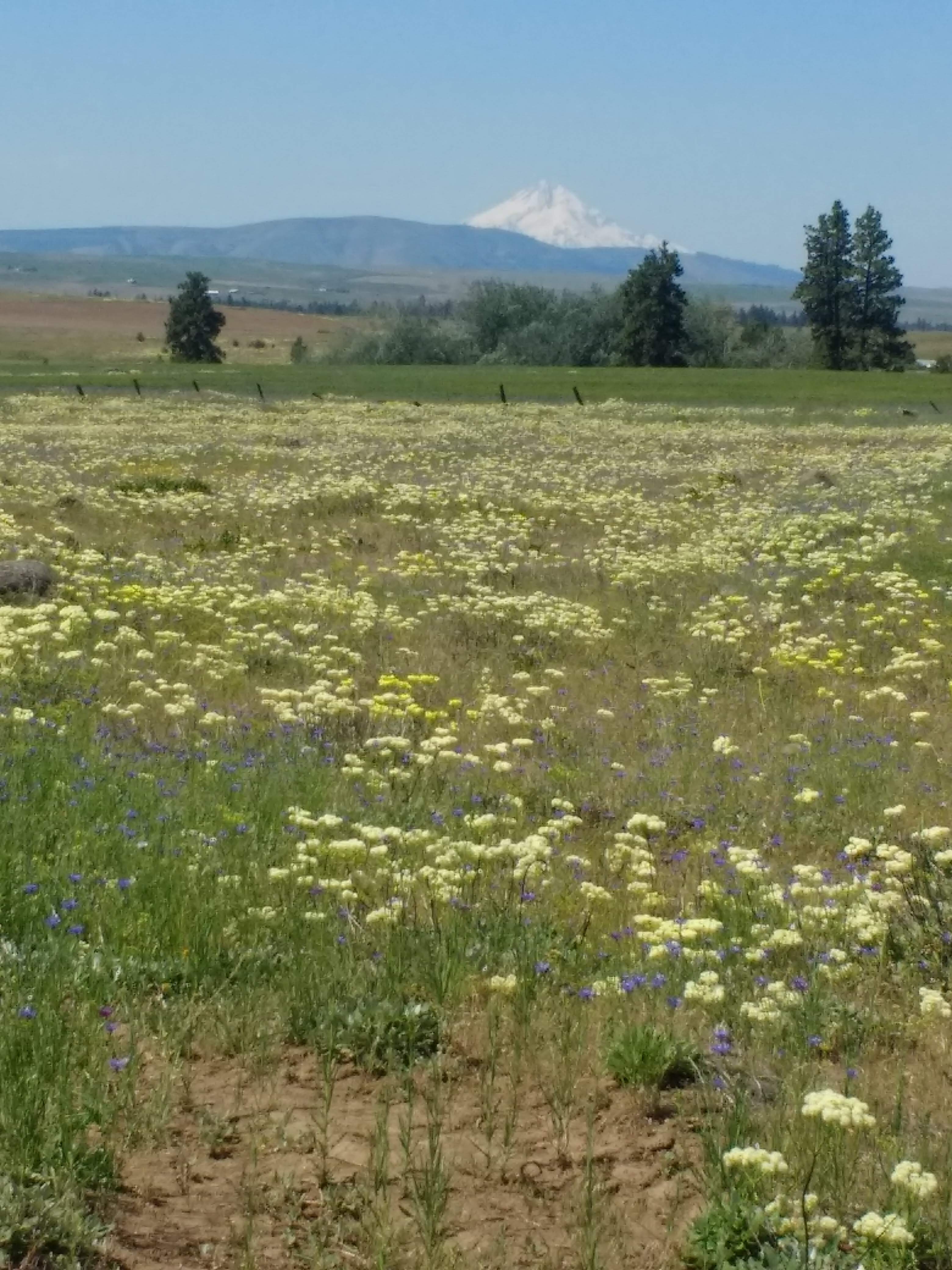
I was in the back seat of our pickup truck. My mom was in the front passenger seat next to my brother who was driving up and over the Old Dalles Mountain Road. It was my dad’s favorite route to take in the springtime, when lupin and balsam root were in full, glorious, purple and gold bloom, bright and vibrant against the dusty silver of sage and the muted brown of soil already cracking underneath their small, but triumphant, canopy of petals.
We were all together, our four-leafed family now plucked to three. There was a gap. A strange, time-warped gap, where I sat mostly in front of a computer screen to work and connect with people but felt the least connection of my life. Life halted, cut off and held hostage by an invisible, global virus, that, if gathered into one place, would fit inside a Pepsi can.

My dad drank a lot of diet Pepsi when I was growing up. It was comforting, that stockpile of cold pop cans in the mud room refrigerator, the sound of the tab snapping open, psssshhcck! on a hot, hot summer day after tilling the garden. Dad’s tanned arms in a cut-off sleeved shirt, his beard trembling a little from his hidden chin wiggling in concentration, his jeans, faded and dirty, his tennis shoes, old and falling apart, leather work gloves worn shiny and brown, and a Mariner’s baseball cap keeping his bald head form burning. These separate articles of clothes hung off of his 6’ 6” frame and contained him. They clothed the certain and habitual gestures of my industrious, earthy, strong parent. This was the dad my eyes were accustomed to resting on and my arms were used to wrapping around for bear hugs. I never had to see or to visit my dad in a mask. His face was always wholly visible, even as it began to slim and slacken and dim.

The work worn clothes, sweat stained baseball caps, muscle, and bone that contained the shape of my dad in the world were burned to ashes and held together in an urn made and fired by one of his long time teaching friends. The heavy weight of last year was lying in there with him, as well as the long wait to take him to his resting place.

I thought he would be light, like ashes caught in an updraft. But no, he was like sand, almost too real. I didn’t want the urn to break, so I held it in my lap. Tightly. I did not want to hold it, either. Was the cancer burned away now? How would he be welcomed by the earth? Ashes are so different than compost. Hydrophobic. No water, no organic material, can attach easily to it. It is free of earthly duty, ready to fly.

Still, I held him in my lap so the jostling from washboards and dislodged rocks on this old, dirt road wouldn’t accidentally break the ceramic container that held him. It took all the strength I had. How could he be so heavy and so gone at the same time? How could I still be so scared of making contact with other humans, of breathing another’s air, and still desire to touch and mingle voice and smile and smell and taste at the same time? How could I have been so far away as he was dying of cancer and not realize how much it would hurt not to hug him at the same time?

Dad didn’t leave me any coaching tips for this.

There was a road sign at the top of the mountain, of all places. Who on god’s green earth would see it, or need it, up there? This wasn’t god’s green earth. It was brown and dusty. There were no other ways to go, no other roads to take, no choices to contemplate. Nevertheless, this road was marked by a green sign that read, “Bryan’s Road.” My dad’s name, only with a “y” instead of an “i”.

Despite the name, we were still unsure whose road this really was. The land up here seemed unclaimable. Too remote and close to the sky to thrust private stakes into it, yet thrust and privatized it was. But the view was stunning, and the sign had his name on it, so we felt justified as we timidly crunched our tires down the barely graded gravel, quietly passed through a cattle guarded gap in the barbed wire fence, and parked out of sight from the rough shod shed just off to the west.

We had arrived.

I opened the door and slid off of the back seat, dad’s weight pushing my footsteps down into the dusty soil. Despite this, I felt wholly untethered, stumbling through sage brush on this high, high, wind-swept hill surrounded in every direction but the east by mountains.

There, to the north, Mt. Rainier, the mountain nearest Seattle, where dad was born in 1946 and lived with his parents, older brother, and younger sister in the house his dad built in the Rainier Valley. He lived there until he left for college on the other side of the state where there were no mountains, just acres of wheat fields. I could see Mt. Rainier’s summit, gleaming like the fond memory of a favorite teacher, peeking above the darkened outline of the Simcoe Hills that made up the northern border of the valley where we lived.

You had to climb this high to see that far.

Sweeping my eyes slightly west I saw the gray, flat-topped form of the once perfectly conical Mt. St. Helens, the mountain that erupted while dad and mom were still young parents, new teachers, first time homeowners, and rained an inch of lighter than air ash on their new deck in 1980 just outside of Portland, Oregon. I was four years old.

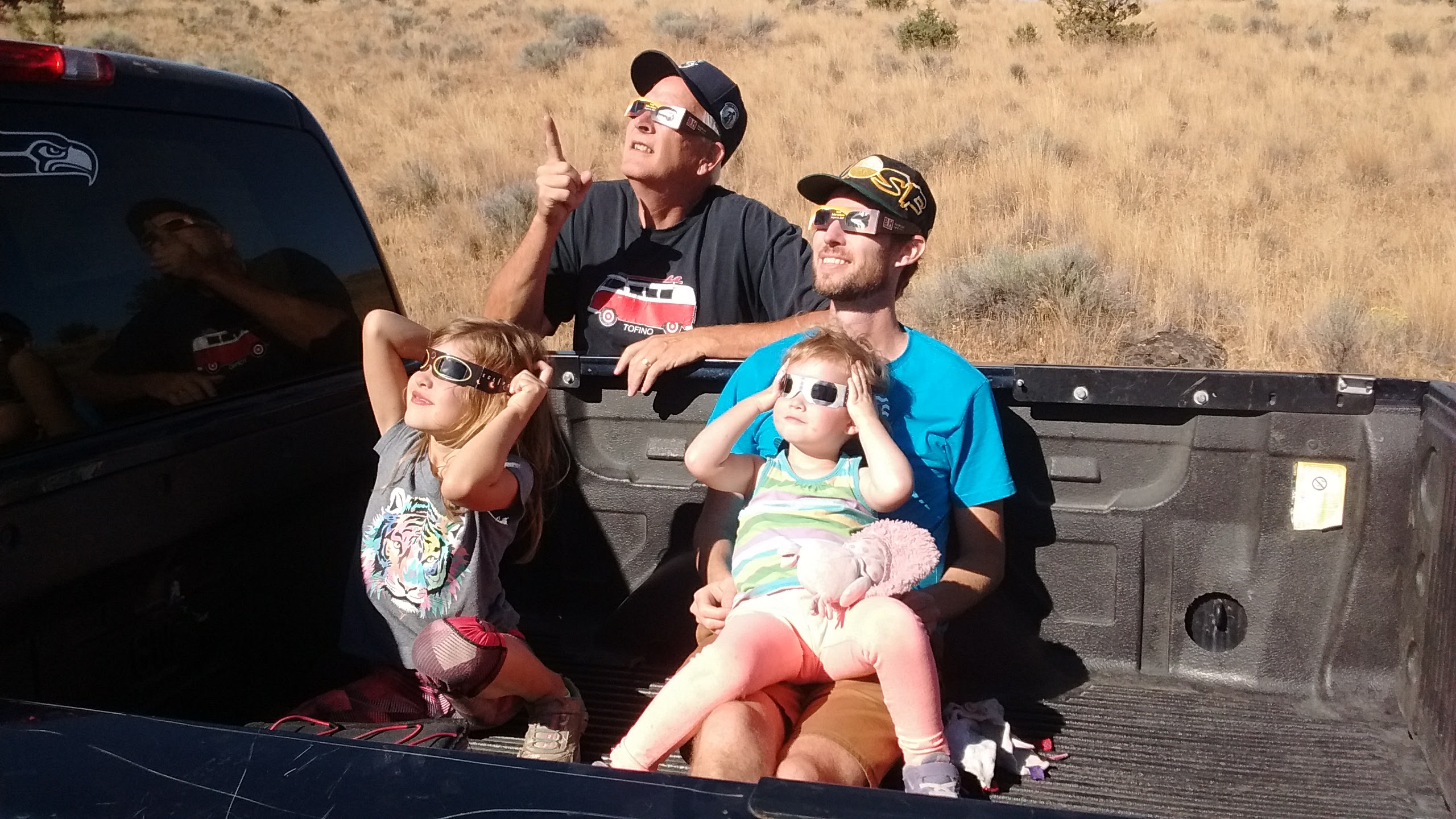
I continued the turn counter clockwise until I was facing south, gazing on Mt. Hood across the Columbia River and into Oregon, a distant but familiar face that so captivated my dad when the blue and white tails of the brightest comet in history, Hale-Bopp, streaked over her summit in 1997 a thousand times brighter and thirty-nine times more deadly than Halley’s comet (which I watched fly from the top of his shoulders when I was 10). Thirty-one years after Halley and twenty years after Hale-Bopp, dad and I drove to central Oregon with my husband and two very young daughters, pulled off to the side of a desert road, plastered paper and plastic glasses to our eyes, and were totally eclipsed for two minutes and forty seconds.
And finally, I turned back to the northwest, to the closest mountain, Mt. Adams, the mountain that would accompany him for most of his life, and mine. The mountain I looked for every time I crested the Columbia River Gorge and returned home. The mountain where we pitched our tent and picked huckleberries in the skirts of her southeast forests in late summer. The mountain our eyes sought out from the back porch of the house that mom and dad helped build to watch winter sunsets kiss her southern slopes and summer sunsets ignite her ancient form from behind, throwing rays of gold and orange and pink into the sky. On early summer mornings, the sun painted her the palest pinks and creamsicle oranges as we drove out to the alfalfa fields to change irrigation lines. Dad spent the last week of his life in my room, Mt. Adams looking in on him through the bedroom window.

From this high place, we could see his life in mountains.

From this high place, we let dad go. His ashes—the twin tails of a once-in-a-lifetime comet, the radiant beams of a sunset, the sudden clear rays of a solar corona—appeared, startling and singular, and then vanished, carried by wind, out over the mountains.

Hungry, Hungry Soil

A meditation on food and flowers.

All the food we eat, from fast food fries to oat milk to bartlett pears to the most delicately thin slice of taro root, has its beginnings in the soil.

Without soil, there is no forest.

Without soil, there is no fen.

Without soil, there is no farm.

Without soil, there is no food.

Soil is a living, breathing, delicately balanced life force, like a magic carpet covering the earth. Scratch it, put a seed just half an inch down, moisten it, warm it, and a tomato plant grows! A magical medium, a mineral mystery.

The skin of the earth is alive, and we live off of its vitality. Some of us live off of it quite literally making a living from cultivating the soil and growing cash crops, trees, or pasture. Some live off of the soil by collecting what it nurtures—nuts, roots, seeds, grasses, bark, and cattails. Some companies scrape topsoil from its native land and sell it in plastic bags or dump it on a new home lot to smooth out the hills and bumps. Without topsoil, alive and slowly, constantly forming, we would have nothing to look at or eat.

We eat and drink the Earth.

Can you think of one thing you ate or drank today that does not come from the soil? This might seem like a silly question, but let’s see where it takes us.

Scrambled eggs.

The eggs that most western cultures eat come from chickens, millions and millions of chickens being raised on farms. Or, for my family, the one in our backyard (her name is Marylin, and she occasionally lays the sweetest little brown eggs, they’re called fairy eggs). These chickens must eat for their bodies to create that egg, and if they are lucky hens, they are let out to eat grass and bugs every day. Grass that grows from the soil and bugs that live in and eat that same soil. And the more grass and bugs those chickens eat, the more nutritious the egg.

And butter for the pan? Same sort of pattern. Millions of cows in the United States are raised for beef, but also some for milk, and, if they are lucky cows, they are let out to eat grass every day. Bacteria help the cow to turn that grass into sun-fueled globules of fatty lactose that come out as milk that we then make into butter, yogurt, cheese, kefir, and the list goes on.

Olive oil.

Instead of butter? Fair enough, from olives that grow from trees that need the sandy, mineral rich nutrients of the Mediterranean or California.

Bread or oatmeal? Made from finely milled seeds of various grasses—rye, wheat, barley, emmer, einkorn—that used their fungus lined roots to draw nutrients and water from the soil.

Lobster.

Imagine. Invisible bacteria, phytoplankton, and algae are making their own energy from the sunlit saturated upper levels of the ocean. Even the abyssal bottom of the ocean floor is spewing chemical nutrients from deep within the planet into the blackest of water where microorganisms use them to make food in the absence of light. And those invisible organisms are the bedrock of an ocean-sized food chain, microscopic food to feed whales and salmon, shrimp and clams, sharks and octopus. Us.

Hamburgers, hotdogs, milk, peanut butter, tofu, the list will go on and on.

Coffee and chocolate? Yes, let’s stop there for a sweet second. Both are made from beans that come from plants that are the complex and delicious result of pre-fermented seeds planted in tropical soils.

It takes a leap of the imagination to get to the soil from every single thing that we eat, but it is not a huge, insurmountable leap. No, it’s more like a pause before taking that first sip of coffee or tea in the morning. An imaginative pause to close our eyes and envision where the beans and tea leaves originated. Arabica? Dig deeper. Are they from South America? Africa? Asia? Were they grown under the wings of birds in mountain forests, or on a clear-cut plantation that removed native trees so good for the soil the coffee and tea came from? Who picked them? How much were they paid? Do they get to eat the food they harvest?

Cereal? The ingredient list on the side of the box is like an inventory of soil minerals—zinc, copper, phosphorous, magnesium, iron, and calcium to name a few. It’s more like eating a soil sample than a box of Wheaties.

Tortillas? The seeds of an annual grass, maize, ground and flattened and patted or pressed into savory circles to be filled with beans or meat or cheese. One of the best tasting meals I ever had was called a papusa. It was made everywhere in El Salvador, but the first one I had was made a roadside stand, a papuseria. I watched them take the ground maize mixed with water, expertly shape it into a neat circle, place cheese, meat, refried beans, or even edible flowers in the middle that they covered up with more cornmeal, and slap it on a large, round griddle. Giant jars of fermented cabbage, curtido, were on tables outside, ready to put on top. Papusas were sunshine in my mouth.

The average rate of soil replenishment is 100 years per inch. In the United States, we use soil 10 times faster than that. Some estimates predict just 60 years of topsoil left in the world. A recent study published in 2021 by three geoscientists at the University of Massachusetts provides a staggering number. An average of 35% of the topsoil in the Midwest, what was once described as a rich, silky mousse, is now completely lost from over tilling, wind, and water erosion.

Mathematically speaking, we need to balance soil withdrawals with compost deposits before we lose any more. Biologically speaking, soil is a living organism made up of other living organisms, minerals, water, and air and needs to be fed in order to stay alive. Geologically speaking, soil is the very youngest, the thinnest, the tip top of earth’s layered history. Soil is just a century old, but the oldest rocks, found in the depths of Australia, are 4.4 billion years old and caught glimpses of the birth of our moon. Spiritually speaking, soil is more than the sum of its individual parts—clay, silt, and ancient sand. These tiny particles, hewn from the cooled rock of earth’s molten core are knit together by lichen, bacteria, and fungus until they can support cells that live off minerals and sunshine. Until they become soil.

After WWII, industrial agriculture took hold and chemical technology moved from the military field to the crop field. The results were immediate and green. But decades of increasing fertilizer and pesticide application resulted in tractor-compacted subsoil and heavy losses of trace minerals, micronutrients, fungi, bacteria, and other micro-organisms that give soil life. We are only just beginning to understand the importance of macrobiotics in farming.

Like native flora and fauna, we’ve lost native soil, some of it never to be recovered. Who knows how many millions of microscopic life forms have lived and died and gone extinct right under our noses. What did they look like? What did they do? Were they replaceable? Life is morphing constantly, but we’ve cut it short, unnaturally so.

The fertility, water holding capacity, and tilth of soil comes from biological diversity. When biology is replaced with monocropping and chemical fertilizers, it is like replacing a soil’s earthy vocal cords with a human tape recording. Instead of singing its native song, a field can only say “corn, corn, corn” and this field only “wheat, wheat, wheat” with an occasional season of fallow silence. Pretty soon, a field is completely expressionless without chemical assistance.

I do believe that, given time and various forms of compost, fields will begin to sing their native songs again. There is no use telling them what tune is acceptable. “Weeds” (many of which turn out to be important native plants) pop up like notes out of place and horribly out of tune with our idea of a field. At first, they seem an eyesore compared to the beautiful, sterile, chemically induced waves of grain we are so used to driving past. But the miracle is that soil, in partnership with farmers and gardeners who see the value in a living, singing soil, can heal with time and compost, and I am looking forward to the symphony.

Miracles, Parables, and Oracles

I’m orange peels, I’m coffee grounds, I’m wisdom! 

Marjory the Trash Heap

I can’t say that I’ve ever witnessed a miracle. I’ve always imagined miracles being pretty obvious things to see—walking on water (I have a paddle board that gets me pretty close), never ending baskets of food (grocery stores in the U.S. hardly ever run out of anything, and perhaps that is a miracle that costs too much), water that turns to wine (fermentation kind of does that), lanterns that stay lit even after the oil has run out (there are 5 solar lanterns hanging in my trees, no oil required), paralyzed individuals walk again (there was a dolphin who lived a full life with a prosthetic tail and his story brought me to tears), the blind see (I know they’re just bending the light, but the moment I put on my glasses, the world sharpens), the dead return to life (compost).

It turns out a miracle is (I just now looked it up), profoundly, an object of wonder that causes you to smile. Well, in that case, I’ve witnessed plenty of miracles! A sudden burst of feathered flight when I walk out the back door. The perfectly furred and rounded back of the rabbit that lives in the house. The color of the sky behind Mt. Adams as the earth turns away from the sun.

Miracles happen to us, while oracles speak to us, warn us, shake us, move us as if we were mountains and they were the miracles.

Marjory, or Madame Trash Heap to the Fraggles in Fraggle Rock, a Muppet show that many from my generation will know (and possibly be singing the theme song to right now) was a bespectacled, sentient pile of trash that had seen everything and knew everything and gave advice. Usually she wanted everyone to live in harmony and to take responsibility for their lives. She was a parabolic oracle, and she really was wise.

Garbage is our life’s oracle. Our daily leftovers speak volumes about who we are and what we love and how we live our lives. Sometimes I imagine modern purgatory as a place where you are forced to sit with all of the garbage you ever threw away and wait, in real time, until it completely decomposes. Only then could you ascend to heaven. And it wouldn’t be a combined pile, either. No, you’d have to wait until that Styrofoam cup decomposed (about 500 years) before you could move on to the take-out containers from all of those restaurants. Every person would have to wait as one diaper decomposed at a time and only then move on to the next one. That’s right, the number of years it takes for a diaper to disintegrate (roughly another 500 years) TIMES THE NUMBER OF DIAPERS.

Okay, I confess I imagined it this way because I did use a few disposable diapers alongside all of the thousands of times I rinsed, washed, and dried our cloth ones, and I don’t want to have to sit and wait. I mean, I gotta get some reward, right? Or is this just another version of the parable of the farmworker who came early to the field and got paid the same amount as the one who came just before the sun went down? Sigh, I know the answer. Garbage purgatory is only a fantasy I have, a wish for detritus retribution, to satisfy the desire to have something to hold over every wasteful, thoughtless act of pollution and littering. The final Word. But of course, this is not the way the world works, this is not the way that love works, and if the world is going to move forward, we’ll need to round out the edges, not sharpen them to a point—metaphorical or grammatical.

Compost is never the final word. Compost piles and the words we need to learn how to create them are signposts that invite conversation with the always changing world, that encourage a composter to dive into the deep, dark, unknown waters of change and transformation, of despair becoming hope, of waste becoming treasure. Compost language lives beyond the pale, where there are wildflowers growing in sentient garbage heaps, where there are monsters of leftovers turning into garden gold. Compost is embodied language. Earthed. Embedded. Speak. Write. Revise. Listen. Compost. Try again.

Compost is my oracle. It speaks of renewal. Of raw, rounded, richness generated in my backyard, from my own life’s refuse. Regeneration. Re-dos. It’s not the language we are used to hearing, and definitely not the language that we are used to understanding. It’s a lot like parables, truths that sit alongside other truths. Jewish rabbis often spoke in parables, and Jesus, who was their successor, also spoke in parables with words that could be understood by everyone about what made life good. Compost is a parabolic parable turning words and language upside down, like the prostitute’s hair on Jesus’ oiled feet, to become new again, to become full of light and life.

Here are some compost parables from my own trash heap:

And the disciples asked, how will we know the resurrection? And she answered, “Look at the compost pile, see how it starts a smelly, putrid mass of gloppy food, grass, pumpkin innards, manure, and straw. Yet quietly, with time and without waste, it consumes, digests, and restores the light inside a dark dankness. All good things in life come to an end. You feast, you reap, and from these events come waste. And yet, you waste the waste. Does not the compost pile welcome the waste you have rejected and make it new again?”

And the disciples asked, how can salvation be for everyone? And she answered, “There once was a rich woman who invited all of her friends to a feast. She brought in her best wine and her finest chefs. She depleted all of her grain stores to make the richest breads and squeezed her chickens and cows dry to have enough butter and eggs for the best cakes. But she did not compost what was left over, and for the next seven years her soil was lifeless and she could not raise enough food to host her friends. But those she did not invite, those who waited for the crumbs under her tables, the peels from the kitchen, the scrapings from the plates, and the waste water from the wash basons took the waste, composted it, and grew their own gardens and shared it with their friends.”

And the disciples asked, who will understand how to get into the kingdom of heaven? And she answered, “There once was a sower who scattered seed. Some seed fell on the pavement of an urban street, some in the ditch of a rural road. Some blew on the wind to land in the duff of the forest floor and the rest she threw onto her compost pile in the backyard. The seed that fell on pavement was eaten by pigeons and squirrels and never had a chance to sprout. The seed that fell in the ditch grew, but no one noticed it as they drove by at 80 miles an hour. The seed that fell in the forest duff grew far from people and the raccoons, opossum, rabbits, and deer had a feast. And the seed that fell on the compost grew in size and flavor unlike anything she had seen, and she was amazed at such abundance from her own backyard, so near, so easy and effortless, and from then on she planted, harvested, and composted at home.”

What would it be like if people who lived in cities could suddenly peer into the life of a farmer or fisherman? If the fences suddenly disappeared between them? If someone from inner city Chicago could suddenly smell the sweet barn hay mixed with manure and understand that this is where that pulled pork from the restaurant is coming from? What if a crowd waiting on a corner in Hong Kong to cross the street was suddenly zorped into the middle of an alfalfa field, the same one I used to irrigate every morning and night, the one where I would sing to the bumble bees on the purple flowers and the mountain and sky with all my heart? What if I was zorped into their world? Would we experience being held by the most wondrous body, would we come to feel the skin of the earth on our cheeks, the reflection of light from skyscraper windows, and reciprocate the inhale and exhale, uniting earth and sky? Would we know that we, the humans in between earth and sky, are made of earth but breathe the sky, every day melding and interacting and mingling and tangling ourselves up in her beautiful body?

Miraculous.

It’s only 18 minutes away…

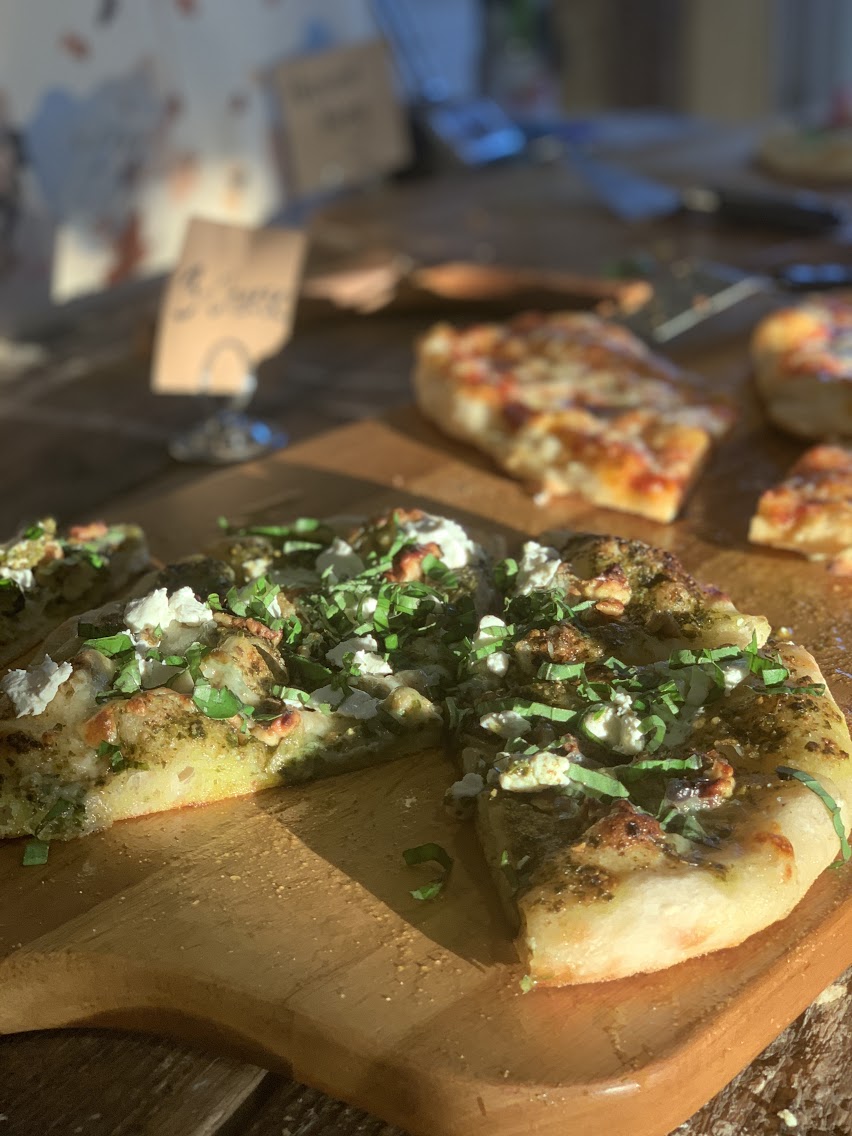
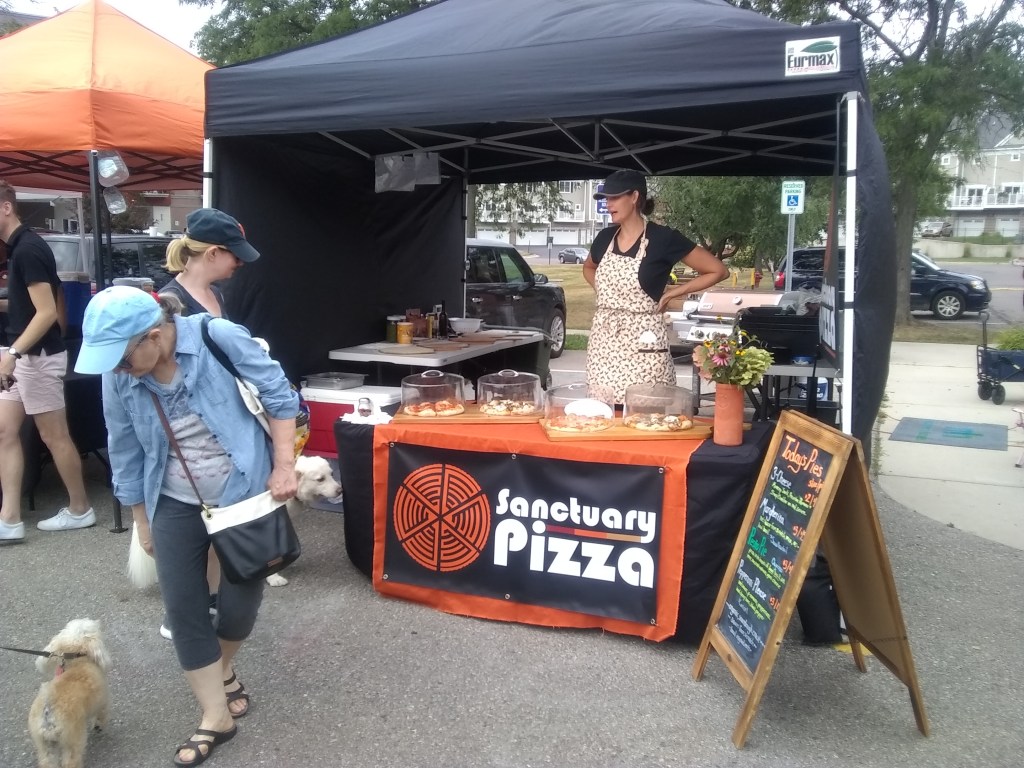
I used to make a lot of pizza. Five every Friday for 2 years and then 40 every Sunday during the farmer’s market season. In all, I made over 1,000 pies in the summer of 2019, and even though I don’t sell them anymore, if you stop by our house on a Friday, well, you’ve come on a Pie Day.

If you are a foodie, local is the magic word. Even better, local organic. Even better, local native.

Let’s start with the crust. Water, wild yeast, and flour. Water, local (Saginaw Sandstone aquifer), check. Wild yeast, local ( floating around my kitchen), check. But let’s face it, local, organic flour? That’s for people in Maine or Oregon who have the passion to make such things possible. Not for a Michigander making 1,000 pies that are affordable. You think in the Midwest you’ll find organic, local flour milled at a local mill?

“B Happy Pie” with local blueberries, basil, and bacon from Trillium Farm

​You know where I’m going. You can. It’s only 18 minutes away from my house.

Ferris Organic Farm. Back in 2018, I ordered whole wheat flour (discontinued, it seems, but millet is so tasty and oats amazing for the body) and some buckwheat from Ferris, and I showed up at the farm in my Honda Accord on a foggy Tuesday. There were a few outbuildings, a place where I could park. The door was closed, but I grew up near my Grandpa’s farm, so I knew not to give up just because people weren’t around. They were probably out doing chores somewhere, and I was conscious that I would be interrupting what is always a tight farm schedule, but didn’t it say to come on Tuesday?

“You should have come on Thursday,” she said, very short and brisk and brusk. She had short, evenly cut hair, tiny feet, and apparently was gluten intolerant. I offered to carry the floury, dusty bags after she checked the order form and took me back into the storage area. The mill for the farm was enormous, and quiet now. The suspended smell of seeds under friction found my nose. I already loved this place.

“You are lucky you found me, otherwise you would have driven all this way for nothing.” I was reminded of Henning, the German farmer I worked for on Lopez Island oh so many years ago, back when I wanted nothing more than have a farm of my own with fence posts I had dug into the ground myself some hot, sunny day. Somehow, in my 20 year old mind, building a fence meant I earned it, owned it. I felt just as happy listening to her kinda-ly chastise me as I felt one morning transplanting tender bean plants in the east orchard after learning I had accidentally planted pole beans next to bush beans and they would cross pollinate, so the bush beans needed to be moved.

Like Henning, she held secrets, years of knowledge that probably went back before she was born, and mysterious tendencies underneath that observant, piercing brow.

Henning used to talk about Norwegian folklore as we worked to make rows out of the field with pick axes (the rototiller used too much gas) for a dry bean experiment that Washington State University was staging at his farm (we had tried last month in the sacrifice field, but without a fence, the dear deer ate his two weeks’ labor in one night.) Day after day we pick axed our way across the acres, him sharing more and more about why biodynamics appealed to his sensibility. It was a mix of traditional knowledge and science, planting on certain days depending on if it was a leaf, flower, fruit, or root crop you’d like to grow. (Today, August 3, the moon is in pisces and it is solely a leaf day, so get that late summer spinach and mache in the ground before tomorrow (a fruit day!)).

I was as fascinated as I was skeptical. Part of me craved this new way of thinking about food. Composting everything in order to create a closed farm system not dependent on fertilizer from outside, herbicides, pesticides, or any other additives. Instead, we made fertilizer from cow horn manure buried under a full moon, dandelions picked in the morning sun just before their petals opened all the way, and chamomile found flourishing in the gravel driveway that we stuffed into deer bladders and let ferment in the ground for a year. The magic was harnessed for the soil, and the soil made celestial foods.

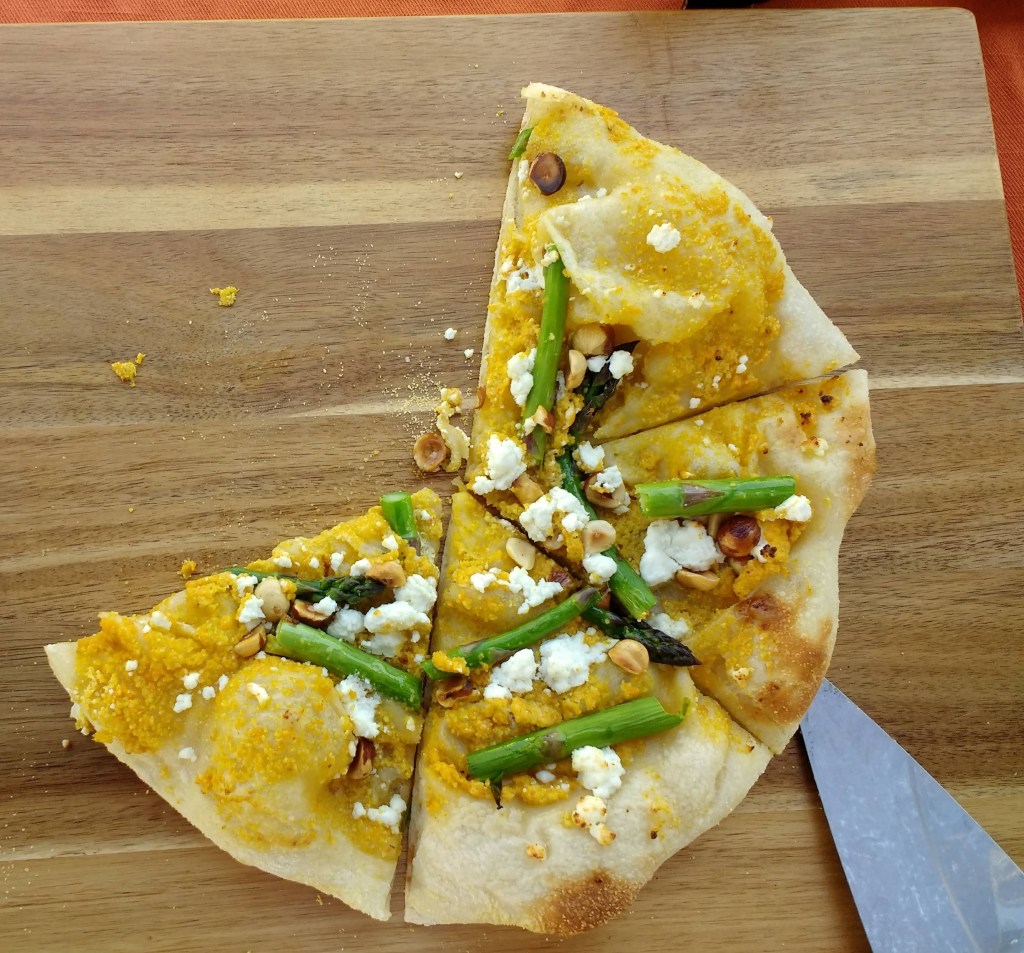
“Spring into New Orleans” with carrot aioli, local asparagus, hazelnuts, and goat cheese

I’ll never know if the buckwheat at Ferris Organics was sprinkled with a brew of nettle tea (delicious), but I had walked on the ground where it came from. I was standing in a space where it lingered for a while after harvest, imbued with the touch of hands, still near the trees where it was planted and raised. (I asked Kroger where their organic flour was grown, but they didn’t know. They don’t know where their ice cream is made, either, but it’s the best ice cream I’ve had).

Listen, you are probably looking at your screen the same way my future husband looked at me when I first met him on Lopez and told him my latest biodynamic task was to “ask” the new tree how it wanted its longest branch oriented (east to west). This is the kind of care and mystical, wonderful potential I want my daughters to see in every tree along their way to school, every beetle burrowed in a milkweed, and every person needing the magic of kindness born of imagination, of empathy. Singing the stories of every life on this earth, not just our own, making space for them to do their healing and wonderful work that weaves in and out of the sometimes silly, sometimes cruel, sometimes beautiful lives of the humans that are here, too.

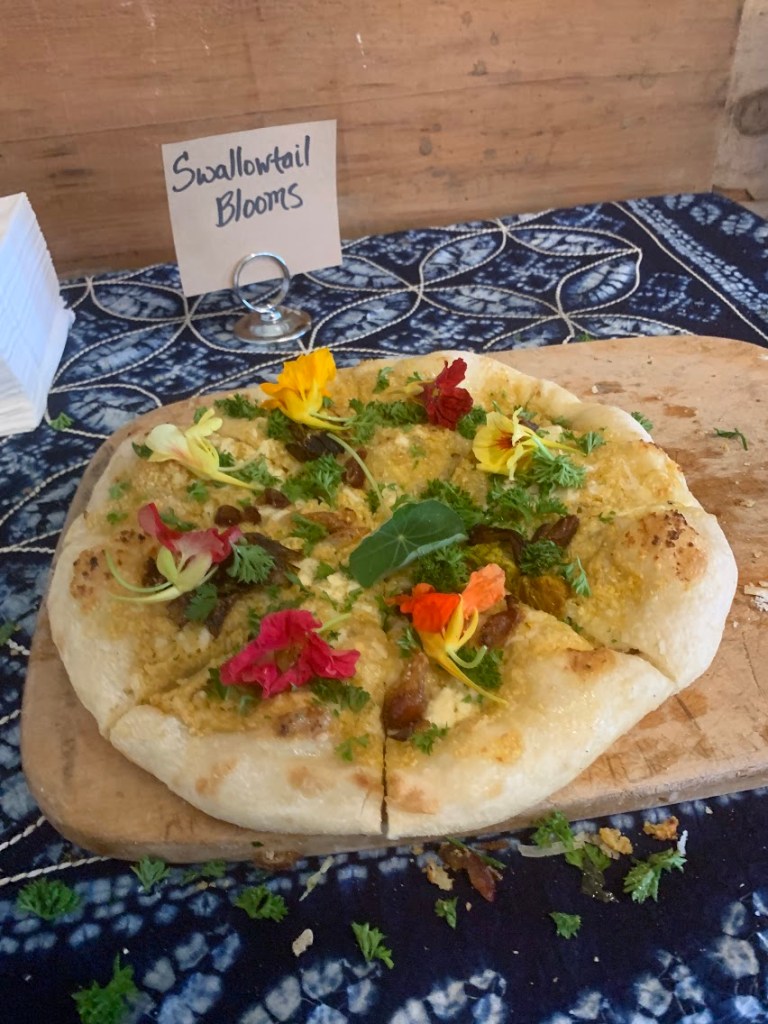
Years after dipping my toe into biodynamics, I was making pizza at Swallowtail Farm for a “pizza at the farm” night. I gave my pizzas some local magic, starting with the crust and ending with the bright, beautiful flowers of squash plants, nasturtium, and basil, a palette of local color and flavor bound for the human palette, to taste colors! To mouth feel late summer! (Wine enthusiasts, you will be familiar with this: biodynamics and terroir and the liquid seasons.) To take into our bellies, hearts, and mental health capacities the energy of the water that opened the seed to cotyledon and nutation, the soil that humbly brought nutrients to root, the farmer that tenderly and gleefully tended its every growth spurt, then with quiet gratefulness cut off its life to feed our own. To mingle our enzymes with foods like water mingles with paint, to paint a canvas of flavors full of light and delight and gratitude and love.

It’s not that far, just 18 minutes away.

Coffee

Thank you God for coffee

That gets me through the day

That keeps me nice and regular

(Maybe that I shouldn’t say)

‘Cause if it weren’t for coffee

I don’t know what I’d do

I’d probly chew tobacco

‘Course there’s marijuana too.

Nah, I wouldn’t chew tobacco,

But coffee stains my teeth

I think I’d use the hash

Cause I’d have better breathe.

Who am I to say

What’s right or good or bad?

When pushing comes to shoving

It’s whatever people have

Around them when they need it,

A mental shift in mood.

Mine’s black and strong with cream

It’s psychoactive too.

In other places it’s totally fine

To drag on this or that.

Culture is such a blinder

I’d rather just forget

About stigma (gasp), taboo

Who needs them anyway?

Thank you God for coffee

That gets me through the day.

Crossover

The crossover
became my move.
Sometime in middle school,
when I went to a summer camp with my friend
whose Dad played Beatles songs the 5 hours it took to get there
(“She loves me, yeah, yeah, yeah”)
Sometime in that week
I used it during a 3 on 3 scrimmage and
the coach, probably a college student,
yelled and cheered, jumped up and down
and ran out on the court and hugged me.
I quietly cried I was so happy
to be hugged by a coach.
So it became my move,
the crossover.
It made people happy,
so i sweat and i teared and i worked
to make others happy.
And those bitter tears?
Those were for disappointing people when i lost.
My relatives and friends who drove hundreds of miles to watch.
Who flew hundreds of miles to watch.
It was too much pressure.
It never occurred to me to play for myself,
to play because i loved it.
I played for others, but I don’t think they knew.
I tried to convince myself I played to glorify God,
but my heart disagreed.
I played for the rush of cheers and hugs,
and they didn’t need to care, really,
because it wasn’t up to them to feed my soul,
but my heart broke, and i became
nothing when college was done.
I had burned myself down
to the bone and i became
nothing
no eating, no feeling,
just running and sacrifice.
Just punishment,
unjustified.
It never occurred to me to forgive myself,
to live for something i loved,
and now, 20 years later, it occurs to me
and my heart is broken for that young woman
who wanted, above anything, to make others happy
because it made her happy, too.