A meditation on food and flowers.
All the food we eat, from fast food fries to oat milk to bartlett pears to the most delicately thin slice of taro root, has its beginnings in the soil.
Without soil, there is no forest.
Without soil, there is no fen.
Without soil, there is no farm.
Without soil, there is no food.
Soil is a living, breathing, delicately balanced life force, like a magic carpet covering the earth. Scratch it, put a seed just half an inch down, moisten it, warm it, and a tomato plant grows! A magical medium, a mineral mystery.
The skin of the earth is alive, and we live off of its vitality. Some of us live off of it quite literally making a living from cultivating the soil and growing cash crops, trees, or pasture. Some live off of the soil by collecting what it nurtures—nuts, roots, seeds, grasses, bark, and cattails. Some companies scrape topsoil from its native land and sell it in plastic bags or dump it on a new home lot to smooth out the hills and bumps. Without topsoil, alive and slowly, constantly forming, we would have nothing to look at or eat.
We eat and drink the Earth.
Can you think of one thing you ate or drank today that does not come from the soil? This might seem like a silly question, but let’s see where it takes us.
Scrambled eggs.
The eggs that most western cultures eat come from chickens, millions and millions of chickens being raised on farms. Or, for my family, the one in our backyard (her name is Marylin, and she occasionally lays the sweetest little brown eggs, they’re called fairy eggs). These chickens must eat for their bodies to create that egg, and if they are lucky hens, they are let out to eat grass and bugs every day. Grass that grows from the soil and bugs that live in and eat that same soil. And the more grass and bugs those chickens eat, the more nutritious the egg.
And butter for the pan? Same sort of pattern. Millions of cows in the United States are raised for beef, but also some for milk, and, if they are lucky cows, they are let out to eat grass every day. Bacteria help the cow to turn that grass into sun-fueled globules of fatty lactose that come out as milk that we then make into butter, yogurt, cheese, kefir, and the list goes on.
Olive oil.
Instead of butter? Fair enough, from olives that grow from trees that need the sandy, mineral rich nutrients of the Mediterranean or California.
Bread or oatmeal? Made from finely milled seeds of various grasses—rye, wheat, barley, emmer, einkorn—that used their fungus lined roots to draw nutrients and water from the soil.
Lobster.
Imagine. Invisible bacteria, phytoplankton, and algae are making their own energy from the sunlit saturated upper levels of the ocean. Even the abyssal bottom of the ocean floor is spewing chemical nutrients from deep within the planet into the blackest of water where microorganisms use them to make food in the absence of light. And those invisible organisms are the bedrock of an ocean-sized food chain, microscopic food to feed whales and salmon, shrimp and clams, sharks and octopus. Us.
Hamburgers, hotdogs, milk, peanut butter, tofu, the list will go on and on.
Coffee and chocolate? Yes, let’s stop there for a sweet second. Both are made from beans that come from plants that are the complex and delicious result of pre-fermented seeds planted in tropical soils.
It takes a leap of the imagination to get to the soil from every single thing that we eat, but it is not a huge, insurmountable leap. No, it’s more like a pause before taking that first sip of coffee or tea in the morning. An imaginative pause to close our eyes and envision where the beans and tea leaves originated. Arabica? Dig deeper. Are they from South America? Africa? Asia? Were they grown under the wings of birds in mountain forests, or on a clear-cut plantation that removed native trees so good for the soil the coffee and tea came from? Who picked them? How much were they paid? Do they get to eat the food they harvest?
Cereal? The ingredient list on the side of the box is like an inventory of soil minerals—zinc, copper, phosphorous, magnesium, iron, and calcium to name a few. It’s more like eating a soil sample than a box of Wheaties.
Tortillas? The seeds of an annual grass, maize, ground and flattened and patted or pressed into savory circles to be filled with beans or meat or cheese. One of the best tasting meals I ever had was called a papusa. It was made everywhere in El Salvador, but the first one I had was made a roadside stand, a papuseria. I watched them take the ground maize mixed with water, expertly shape it into a neat circle, place cheese, meat, refried beans, or even edible flowers in the middle that they covered up with more cornmeal, and slap it on a large, round griddle. Giant jars of fermented cabbage, curtido, were on tables outside, ready to put on top. Papusas were sunshine in my mouth.
The average rate of soil replenishment is 100 years per inch. In the United States, we use soil 10 times faster than that. Some estimates predict just 60 years of topsoil left in the world. A recent study published in 2021 by three geoscientists at the University of Massachusetts provides a staggering number. An average of 35% of the topsoil in the Midwest, what was once described as a rich, silky mousse, is now completely lost from over tilling, wind, and water erosion.
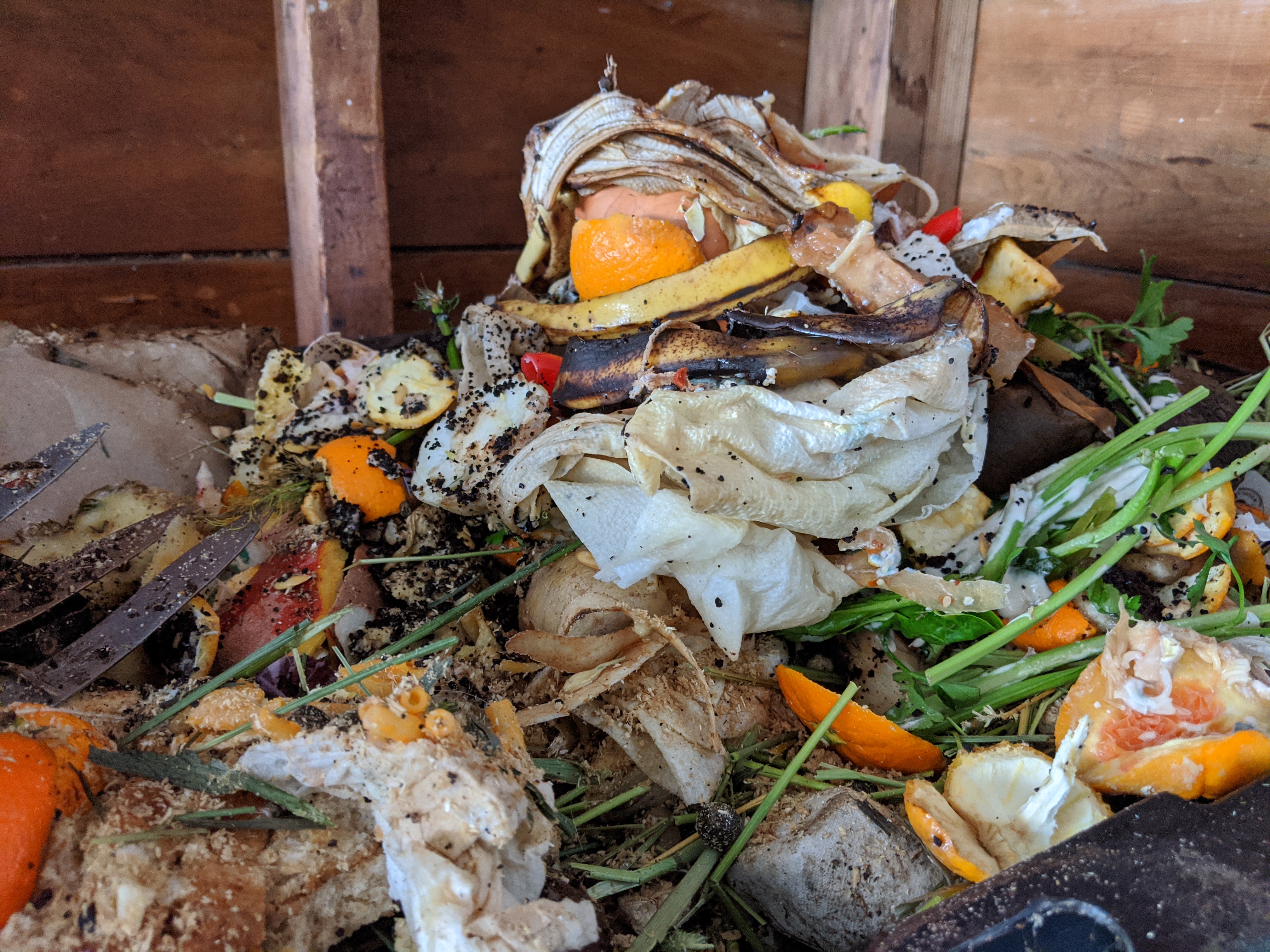
Mathematically speaking, we need to balance soil withdrawals with compost deposits before we lose any more. Biologically speaking, soil is a living organism made up of other living organisms, minerals, water, and air and needs to be fed in order to stay alive. Geologically speaking, soil is the very youngest, the thinnest, the tip top of earth’s layered history. Soil is just a century old, but the oldest rocks, found in the depths of Australia, are 4.4 billion years old and caught glimpses of the birth of our moon. Spiritually speaking, soil is more than the sum of its individual parts—clay, silt, and ancient sand. These tiny particles, hewn from the cooled rock of earth’s molten core are knit together by lichen, bacteria, and fungus until they can support cells that live off minerals and sunshine. Until they become soil.
After WWII, industrial agriculture took hold and chemical technology moved from the military field to the crop field. The results were immediate and green. But decades of increasing fertilizer and pesticide application resulted in tractor-compacted subsoil and heavy losses of trace minerals, micronutrients, fungi, bacteria, and other micro-organisms that give soil life. We are only just beginning to understand the importance of macrobiotics in farming.
Like native flora and fauna, we’ve lost native soil, some of it never to be recovered. Who knows how many millions of microscopic life forms have lived and died and gone extinct right under our noses. What did they look like? What did they do? Were they replaceable? Life is morphing constantly, but we’ve cut it short, unnaturally so.
The fertility, water holding capacity, and tilth of soil comes from biological diversity. When biology is replaced with monocropping and chemical fertilizers, it is like replacing a soil’s earthy vocal cords with a human tape recording. Instead of singing its native song, a field can only say “corn, corn, corn” and this field only “wheat, wheat, wheat” with an occasional season of fallow silence. Pretty soon, a field is completely expressionless without chemical assistance.
I do believe that, given time and various forms of compost, fields will begin to sing their native songs again. There is no use telling them what tune is acceptable. “Weeds” (many of which turn out to be important native plants) pop up like notes out of place and horribly out of tune with our idea of a field. At first, they seem an eyesore compared to the beautiful, sterile, chemically induced waves of grain we are so used to driving past. But the miracle is that soil, in partnership with farmers and gardeners who see the value in a living, singing soil, can heal with time and compost, and I am looking forward to the symphony.







 Motherlife
