I can’t say that I’ve ever witnessed a miracle. I’ve always imagined miracles being pretty obvious things to see—walking on water (I have a paddle board that gets me pretty close), never ending baskets of food (grocery stores in the U.S. hardly ever run out of anything, and perhaps that is a miracle that costs too much), water that turns to wine (fermentation kind of does that), lanterns that stay lit even after the oil has run out (there are 5 solar lanterns hanging in my trees, no oil required), paralyzed individuals walk again (there was a dolphin who lived a full life with a prosthetic tail and his story brought me to tears), the blind see (I know they’re just bending the light, but the moment I put on my glasses, the world sharpens), the dead return to life (compost).
It turns out a miracle is (I just now looked it up), profoundly, an object of wonder that causes you to smile. Well, in that case, I’ve witnessed plenty of miracles! A sudden burst of feathered flight when I walk out the back door. The perfectly furred and rounded back of the rabbit that lives in the house. The color of the sky behind Mt. Adams as the earth turns away from the sun.
Miracles happen to us, while oracles speak to us, warn us, shake us, move us as if we were mountains and they were the miracles.
Marjory, or Madame Trash Heap to the Fraggles in Fraggle Rock, a Muppet show that many from my generation will know (and possibly be singing the theme song to right now) was a bespectacled, sentient pile of trash that had seen everything and knew everything and gave advice. Usually she wanted everyone to live in harmony and to take responsibility for their lives. She was a parabolic oracle, and she really was wise.
Garbage is our life’s oracle. Our daily leftovers speak volumes about who we are and what we love and how we live our lives. Sometimes I imagine modern purgatory as a place where you are forced to sit with all of the garbage you ever threw away and wait, in real time, until it completely decomposes. Only then could you ascend to heaven. And it wouldn’t be a combined pile, either. No, you’d have to wait until that Styrofoam cup decomposed (about 500 years) before you could move on to the take-out containers from all of those restaurants. Every person would have to wait as one diaper decomposed at a time and only then move on to the next one. That’s right, the number of years it takes for a diaper to disintegrate (roughly another 500 years) TIMES THE NUMBER OF DIAPERS.
Okay, I confess I imagined it this way because I did use a few disposable diapers alongside all of the thousands of times I rinsed, washed, and dried our cloth ones, and I don’t want to have to sit and wait. I mean, I gotta get some reward, right? Or is this just another version of the parable of the farmworker who came early to the field and got paid the same amount as the one who came just before the sun went down? Sigh, I know the answer. Garbage purgatory is only a fantasy I have, a wish for detritus retribution, to satisfy the desire to have something to hold over every wasteful, thoughtless act of pollution and littering. The final Word. But of course, this is not the way the world works, this is not the way that love works, and if the world is going to move forward, we’ll need to round out the edges, not sharpen them to a point—metaphorical or grammatical.
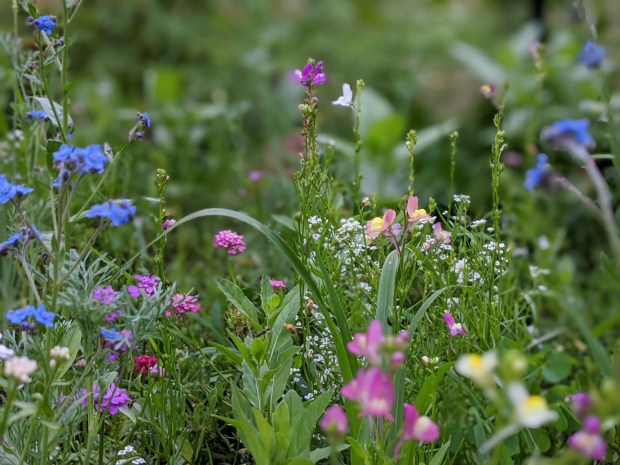
Compost is never the final word. Compost piles and the words we need to learn how to create them are signposts that invite conversation with the always changing world, that encourage a composter to dive into the deep, dark, unknown waters of change and transformation, of despair becoming hope, of waste becoming treasure. Compost language lives beyond the pale, where there are wildflowers growing in sentient garbage heaps, where there are monsters of leftovers turning into garden gold. Compost is embodied language. Earthed. Embedded. Speak. Write. Revise. Listen. Compost. Try again.
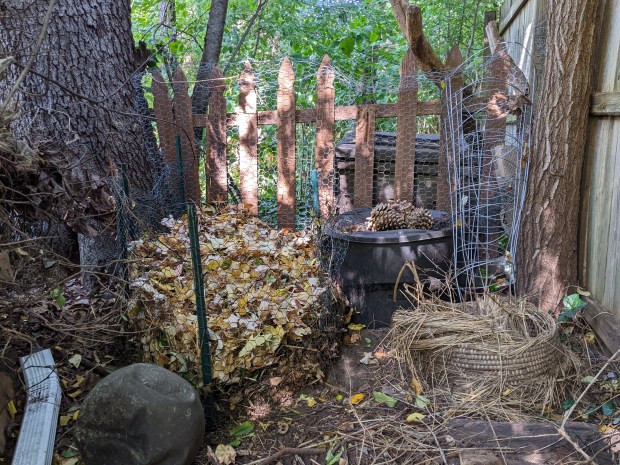
Compost is my oracle. It speaks of renewal. Of raw, rounded, richness generated in my backyard, from my own life’s refuse. Regeneration. Re-dos. It’s not the language we are used to hearing, and definitely not the language that we are used to understanding. It’s a lot like parables, truths that sit alongside other truths. Jewish rabbis often spoke in parables, and Jesus, who was their successor, also spoke in parables with words that could be understood by everyone about what made life good. Compost is a parabolic parable turning words and language upside down, like the prostitute’s hair on Jesus’ oiled feet, to become new again, to become full of light and life.
Here are some compost parables from my own trash heap:
And the disciples asked, how will we know the resurrection? And she answered, “Look at the compost pile, see how it starts a smelly, putrid mass of gloppy food, grass, pumpkin innards, manure, and straw. Yet quietly, with time and without waste, it consumes, digests, and restores the light inside a dark dankness. All good things in life come to an end. You feast, you reap, and from these events come waste. And yet, you waste the waste. Does not the compost pile welcome the waste you have rejected and make it new again?”
And the disciples asked, how can salvation be for everyone? And she answered, “There once was a rich woman who invited all of her friends to a feast. She brought in her best wine and her finest chefs. She depleted all of her grain stores to make the richest breads and squeezed her chickens and cows dry to have enough butter and eggs for the best cakes. But she did not compost what was left over, and for the next seven years her soil was lifeless and she could not raise enough food to host her friends. But those she did not invite, those who waited for the crumbs under her tables, the peels from the kitchen, the scrapings from the plates, and the waste water from the wash basons took the waste, composted it, and grew their own gardens and shared it with their friends.”
And the disciples asked, who will understand how to get into the kingdom of heaven? And she answered, “There once was a sower who scattered seed. Some seed fell on the pavement of an urban street, some in the ditch of a rural road. Some blew on the wind to land in the duff of the forest floor and the rest she threw onto her compost pile in the backyard. The seed that fell on pavement was eaten by pigeons and squirrels and never had a chance to sprout. The seed that fell in the ditch grew, but no one noticed it as they drove by at 80 miles an hour. The seed that fell in the forest duff grew far from people and the raccoons, opossum, rabbits, and deer had a feast. And the seed that fell on the compost grew in size and flavor unlike anything she had seen, and she was amazed at such abundance from her own backyard, so near, so easy and effortless, and from then on she planted, harvested, and composted at home.”
What would it be like if people who lived in cities could suddenly peer into the life of a farmer or fisherman? If the fences suddenly disappeared between them? If someone from inner city Chicago could suddenly smell the sweet barn hay mixed with manure and understand that this is where that pulled pork from the restaurant is coming from? What if a crowd waiting on a corner in Hong Kong to cross the street was suddenly zorped into the middle of an alfalfa field, the same one I used to irrigate every morning and night, the one where I would sing to the bumble bees on the purple flowers and the mountain and sky with all my heart? What if I was zorped into their world? Would we experience being held by the most wondrous body, would we come to feel the skin of the earth on our cheeks, the reflection of light from skyscraper windows, and reciprocate the inhale and exhale, uniting earth and sky? Would we know that we, the humans in between earth and sky, are made of earth but breathe the sky, every day melding and interacting and mingling and tangling ourselves up in her beautiful body?




 Motherlife