Hungry, Hungry Soil

A meditation on food and flowers.

All the food we eat, from fast food fries to oat milk to bartlett pears to the most delicately thin slice of taro root, has its beginnings in the soil.

Without soil, there is no forest.

Without soil, there is no fen.

Without soil, there is no farm.

Without soil, there is no food.

Soil is a living, breathing, delicately balanced life force, like a magic carpet covering the earth. Scratch it, put a seed just half an inch down, moisten it, warm it, and a tomato plant grows! A magical medium, a mineral mystery.

The skin of the earth is alive, and we live off of its vitality. Some of us live off of it quite literally making a living from cultivating the soil and growing cash crops, trees, or pasture. Some live off of the soil by collecting what it nurtures—nuts, roots, seeds, grasses, bark, and cattails. Some companies scrape topsoil from its native land and sell it in plastic bags or dump it on a new home lot to smooth out the hills and bumps. Without topsoil, alive and slowly, constantly forming, we would have nothing to look at or eat.

We eat and drink the Earth.

Can you think of one thing you ate or drank today that does not come from the soil? This might seem like a silly question, but let’s see where it takes us.

Scrambled eggs.

The eggs that most western cultures eat come from chickens, millions and millions of chickens being raised on farms. Or, for my family, the one in our backyard (her name is Marylin, and she occasionally lays the sweetest little brown eggs, they’re called fairy eggs). These chickens must eat for their bodies to create that egg, and if they are lucky hens, they are let out to eat grass and bugs every day. Grass that grows from the soil and bugs that live in and eat that same soil. And the more grass and bugs those chickens eat, the more nutritious the egg.

And butter for the pan? Same sort of pattern. Millions of cows in the United States are raised for beef, but also some for milk, and, if they are lucky cows, they are let out to eat grass every day. Bacteria help the cow to turn that grass into sun-fueled globules of fatty lactose that come out as milk that we then make into butter, yogurt, cheese, kefir, and the list goes on.

Olive oil.

Instead of butter? Fair enough, from olives that grow from trees that need the sandy, mineral rich nutrients of the Mediterranean or California.

Bread or oatmeal? Made from finely milled seeds of various grasses—rye, wheat, barley, emmer, einkorn—that used their fungus lined roots to draw nutrients and water from the soil.

Lobster.

Imagine. Invisible bacteria, phytoplankton, and algae are making their own energy from the sunlit saturated upper levels of the ocean. Even the abyssal bottom of the ocean floor is spewing chemical nutrients from deep within the planet into the blackest of water where microorganisms use them to make food in the absence of light. And those invisible organisms are the bedrock of an ocean-sized food chain, microscopic food to feed whales and salmon, shrimp and clams, sharks and octopus. Us.

Hamburgers, hotdogs, milk, peanut butter, tofu, the list will go on and on.

Coffee and chocolate? Yes, let’s stop there for a sweet second. Both are made from beans that come from plants that are the complex and delicious result of pre-fermented seeds planted in tropical soils.

It takes a leap of the imagination to get to the soil from every single thing that we eat, but it is not a huge, insurmountable leap. No, it’s more like a pause before taking that first sip of coffee or tea in the morning. An imaginative pause to close our eyes and envision where the beans and tea leaves originated. Arabica? Dig deeper. Are they from South America? Africa? Asia? Were they grown under the wings of birds in mountain forests, or on a clear-cut plantation that removed native trees so good for the soil the coffee and tea came from? Who picked them? How much were they paid? Do they get to eat the food they harvest?

Cereal? The ingredient list on the side of the box is like an inventory of soil minerals—zinc, copper, phosphorous, magnesium, iron, and calcium to name a few. It’s more like eating a soil sample than a box of Wheaties.

Tortillas? The seeds of an annual grass, maize, ground and flattened and patted or pressed into savory circles to be filled with beans or meat or cheese. One of the best tasting meals I ever had was called a papusa. It was made everywhere in El Salvador, but the first one I had was made a roadside stand, a papuseria. I watched them take the ground maize mixed with water, expertly shape it into a neat circle, place cheese, meat, refried beans, or even edible flowers in the middle that they covered up with more cornmeal, and slap it on a large, round griddle. Giant jars of fermented cabbage, curtido, were on tables outside, ready to put on top. Papusas were sunshine in my mouth.

The average rate of soil replenishment is 100 years per inch. In the United States, we use soil 10 times faster than that. Some estimates predict just 60 years of topsoil left in the world. A recent study published in 2021 by three geoscientists at the University of Massachusetts provides a staggering number. An average of 35% of the topsoil in the Midwest, what was once described as a rich, silky mousse, is now completely lost from over tilling, wind, and water erosion.

Mathematically speaking, we need to balance soil withdrawals with compost deposits before we lose any more. Biologically speaking, soil is a living organism made up of other living organisms, minerals, water, and air and needs to be fed in order to stay alive. Geologically speaking, soil is the very youngest, the thinnest, the tip top of earth’s layered history. Soil is just a century old, but the oldest rocks, found in the depths of Australia, are 4.4 billion years old and caught glimpses of the birth of our moon. Spiritually speaking, soil is more than the sum of its individual parts—clay, silt, and ancient sand. These tiny particles, hewn from the cooled rock of earth’s molten core are knit together by lichen, bacteria, and fungus until they can support cells that live off minerals and sunshine. Until they become soil.

After WWII, industrial agriculture took hold and chemical technology moved from the military field to the crop field. The results were immediate and green. But decades of increasing fertilizer and pesticide application resulted in tractor-compacted subsoil and heavy losses of trace minerals, micronutrients, fungi, bacteria, and other micro-organisms that give soil life. We are only just beginning to understand the importance of macrobiotics in farming.

Like native flora and fauna, we’ve lost native soil, some of it never to be recovered. Who knows how many millions of microscopic life forms have lived and died and gone extinct right under our noses. What did they look like? What did they do? Were they replaceable? Life is morphing constantly, but we’ve cut it short, unnaturally so.

The fertility, water holding capacity, and tilth of soil comes from biological diversity. When biology is replaced with monocropping and chemical fertilizers, it is like replacing a soil’s earthy vocal cords with a human tape recording. Instead of singing its native song, a field can only say “corn, corn, corn” and this field only “wheat, wheat, wheat” with an occasional season of fallow silence. Pretty soon, a field is completely expressionless without chemical assistance.

I do believe that, given time and various forms of compost, fields will begin to sing their native songs again. There is no use telling them what tune is acceptable. “Weeds” (many of which turn out to be important native plants) pop up like notes out of place and horribly out of tune with our idea of a field. At first, they seem an eyesore compared to the beautiful, sterile, chemically induced waves of grain we are so used to driving past. But the miracle is that soil, in partnership with farmers and gardeners who see the value in a living, singing soil, can heal with time and compost, and I am looking forward to the symphony.
Way to Compost 5: Bed Rest

Not everyone has access to a large piece of land where they can hide a compost pile in a shady corner or stock pile lots of material. Not everyone will be visiting their garden on a regular basis, keeping it free of weeds and plants that have gone to seed.

Community or church gardens will be tended by several people, and the compost pile might be added to as people come and go. At some point it will certainly be drying up in a forgotten corner requiring a major effort to get going again. On a lazier note, sometimes I just don’t want to haul raw materials out of the garden gate to the compost pile, compost them, then haul them all back in again with a wheelbarrow.

If any of these sound familiar, or if you want to save a little time and labor, a garden “bed rest” is your compost ticket.

One fall day, I was standing in the garden just looking and not doing anything, which is usually when good ideas materialize. There was a lot to be done. Old tomato vines drooped in their cages, the squash plants had turned to mush with the morning frost, and the mustard had already gone to seed. I did not feel quite energetic enough to pull it all up, take several trips with the wheelbarrow to the compost pile out back, build the pile, then bring it all back in again in the spring. Too many trips!

Inspiration struck.

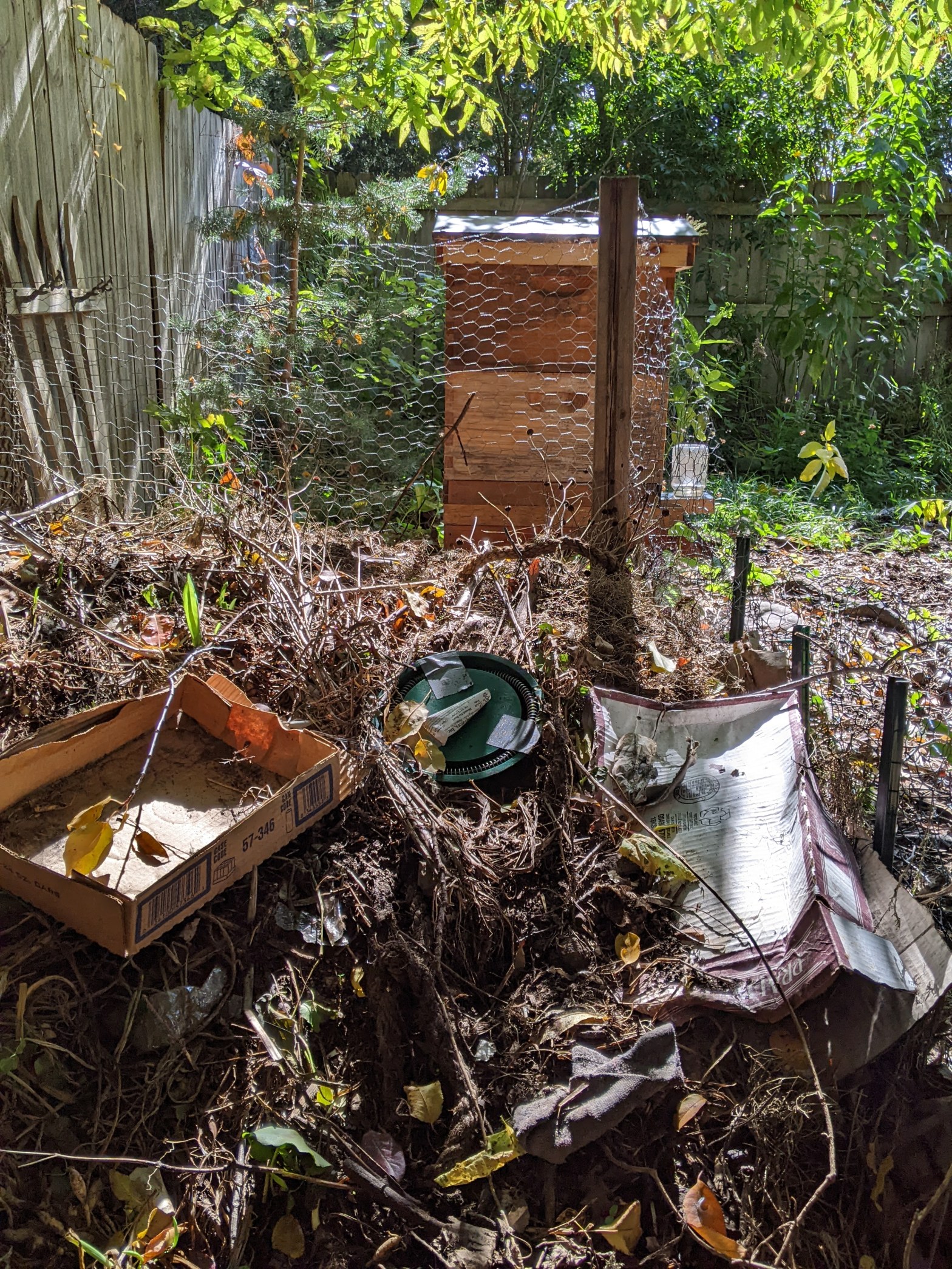
I went to the garage to find some chicken wire and staked it around the outline of one of the garden beds, maybe 3’ by 5’, and built the pile right on top of it. Right in the middle of the garden. I felt gleefully lazy.

Like every compost pile, I did my best to have both green and brown material in the mix. It wouldn’t be a perfect ratio, probably heavier on the brown, carbony stuff, but my goal was not to make a hot compost pile. This pile would sit and slowly compost all winter, so I wasn’t too worried about getting the ratio just right. I forked up the soil in the bed a bit and began with a layer of bulkier stuff on the bottom (tomato vines and old, woody radishes), then I layered brown and green stuff to a height of about two feet. I hauled in some fall leaves and old straw for the browns. I had some kitchen scraps sitting in a lidded garbage can that I brought in for greens, as well as anything left in the garden that wasn’t going to be eaten (mushy pumpkins, old tomatoes, and lettuce gone to seed). I was fortunate enough to have chickens, so I cleaned out the chicken house and used the mixture of manure, straw, and feathers to help heat up the pile. If you don’t have access to chicken manure, (the “hottest” of all manure, meaning it has a lot of nitrogen in it), you can buy a bag of bone or blood meal from a nursery or grain growers to sprinkle on top of each layer.

I often use stakes and chicken wire to contain compost and leaves

Instead of hauling everything out and then back in again, I was just hauling it in to stay. It was very satisfying to clean up fall leaves, the chicken house, and the kitchen scrap bin in one go and have a compost pile I wouldn’t have to move later to show for it.

When I was done, I covered it with old straw and went inside pretty pleased with myself. Using my compost thermometer, I checked on it after a week or so. The pile made it to about 100 degrees F, which is a good start.

Throughout the fall, the microorganisms worked on it. In the winter, they took a rest, too. In the spring, they started up again, and when the ground warmed up enough, and I had a burst of energy, I took away the chicken wire, scraped off the top layer of straw, and went to work turning the pile straight into the soil. No wheelbarrow necessary! I gave the soil another couple of weeks to incorporate the compost, then planted right into it.

It was as fluffy as a raised bed, compost included.

After that, I included a compost “bed rest” right into my usual garden rotation.

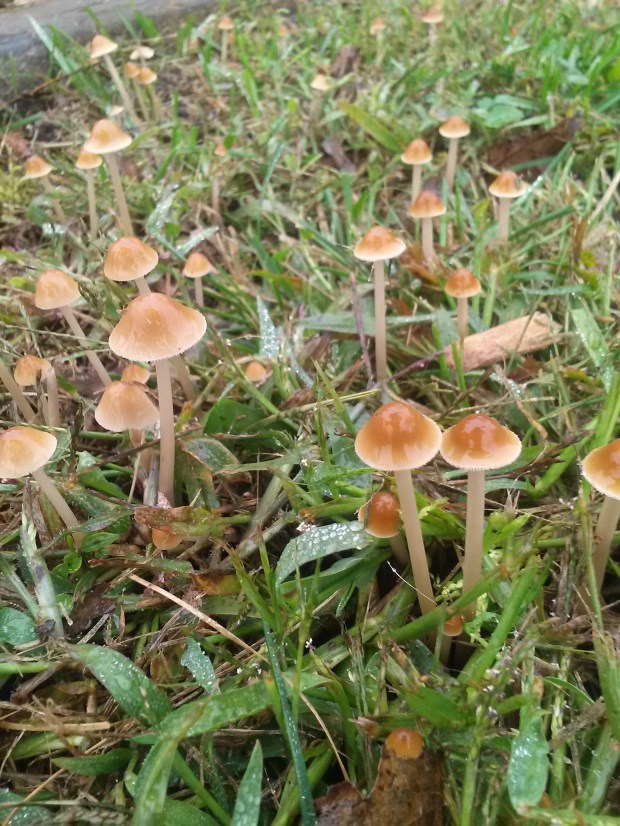
The less you disturb soil, the more mushrooms will grow! Sometimes nature doesn’t need us to work so hard, she’s got it covered in her own miraculous, astonishing ways.

I haven’t tried this yet, but if you need more nitrogen in the soil, plant a cover crop that procures it from the air (any kind of legume, vetch, or clover), then build the compost pile right on top of that (bonus, no need to turn that cover crop in by hand!) in order to break down the cover crop, adding nitrogen to the soil, and add compost at the same time.

In the summer, it would be possible to build a compost pile on top of a bed and add worms to the mix in order to break the pile down even further.

The compost-abilities are endless!

Cross country skiing at Harris Nature Center

Snow falls from the sky,
Clings to pine needles and sycamore limbs
That canopy Red Cedar River.
Snow falls again.
Ploosh,
Into water almost frozen.
It is cold, so cold.

Breathlets nestled deep in our lungs
Rise warm and swift, 
Like birds startled from our mouths,
Whirl to the treetops,
Warm a bottom branch to the nth degree.
Enough to trigger release, 
A silent descent, 
Soft splash, 
Frozen water into flowing water, 
Sisters meet again.
Easily, as if they had known
All along.
At last.
Softly. 
Stunning.
This is the sound of unexpected understanding. 
Of grief. 
Water into water.
This is the tender sigh of crystal edge into liquid embrace.
Of forgiveness.
Water into water.
This is the audible moment of transformation, a subtle shift of flow.
Of bloom.
Water into water.
This is the symphony of comet tails brushed across the sky, at speed, Melting into the river of space.
Of whales gliding through oceans and rain saturating 
The soil, quenching its filamentous thirst.
Water into water.

Compost where?

There are two important places where compost happens in nature: the forest floor and inside stomachs.

The forest floor is a slow, sweet smelling compost pile we call duff.  Duff even sounds muted and mysterious, a substance with tiny secrets and tantalizingly familiar smells. Leaves created through the miraculous process of photosynthesis—a process made possible by a bacteria containing chlorophyll that can capture light to make energy and food—fall back to the earth and are broken down by earthy critters into smaller and smaller pieces until they become food for soil microorganisms.  This transformation has sustained forests for thousands of years.

The first shredders.

could you hear them if you paused,

ear to the ground, like the popping sound

of fish munching on coral underwater?

All of Mother Earth is being savored,

tasted, taken in, from forest to ocean to farm,

teeth and jaws gnawing away on our giant earthcicle,

passing particles through guts, working them deeper

and deeper into the ground until what once was leaf or twig

or even beetle or bone has become so small that soil microbes,

bacteria and fungus and slime mold, are able at last to access energy,

metabolize fallen sunspots, release stardust

back into soil where tree roots are waiting like open hands

to carry nutrients up and up to the canopy to be

knitted into next year’s leaves.

Slime mold: it appeared in the garden out of nowhere and has never been seen again!

These microscopic bodies live, transform, and die without being seen in order to move the wheel of life forward. To take what is dead and transform it into a spark of life. A wonder. This is bodily, physical, and it can make us uncomfortable. It can turn our stomachs.

And our stomachs are the other place compost happens in nature. Stomachs and intestines combine to make an oxygen deprived compost tank inhabited by millions of microorganisms. The most efficient stomachs belong to ruminant (“room-in-it”) animals. They include sheep, goats, giraffes, deer, and llamas. Ordinary as they are, the inside of a ruminant’s stomach holds another one of life’s great mysteries. Ruminants can miraculously turn plant nitrogen into protein with the help of bacteria that scientists believe to be over 3.6 billion years old (archaebacteria), fungi, and protozoa.

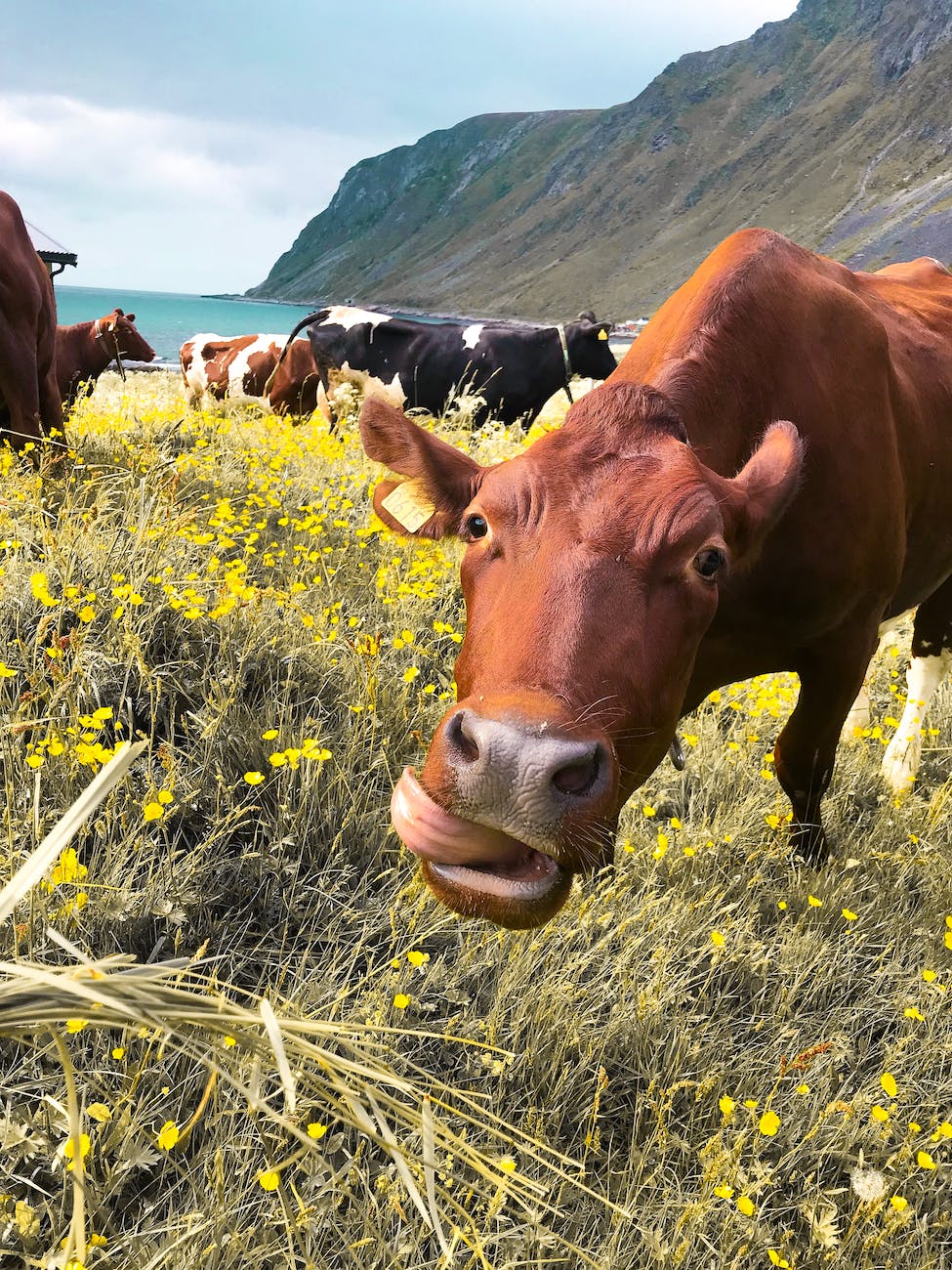
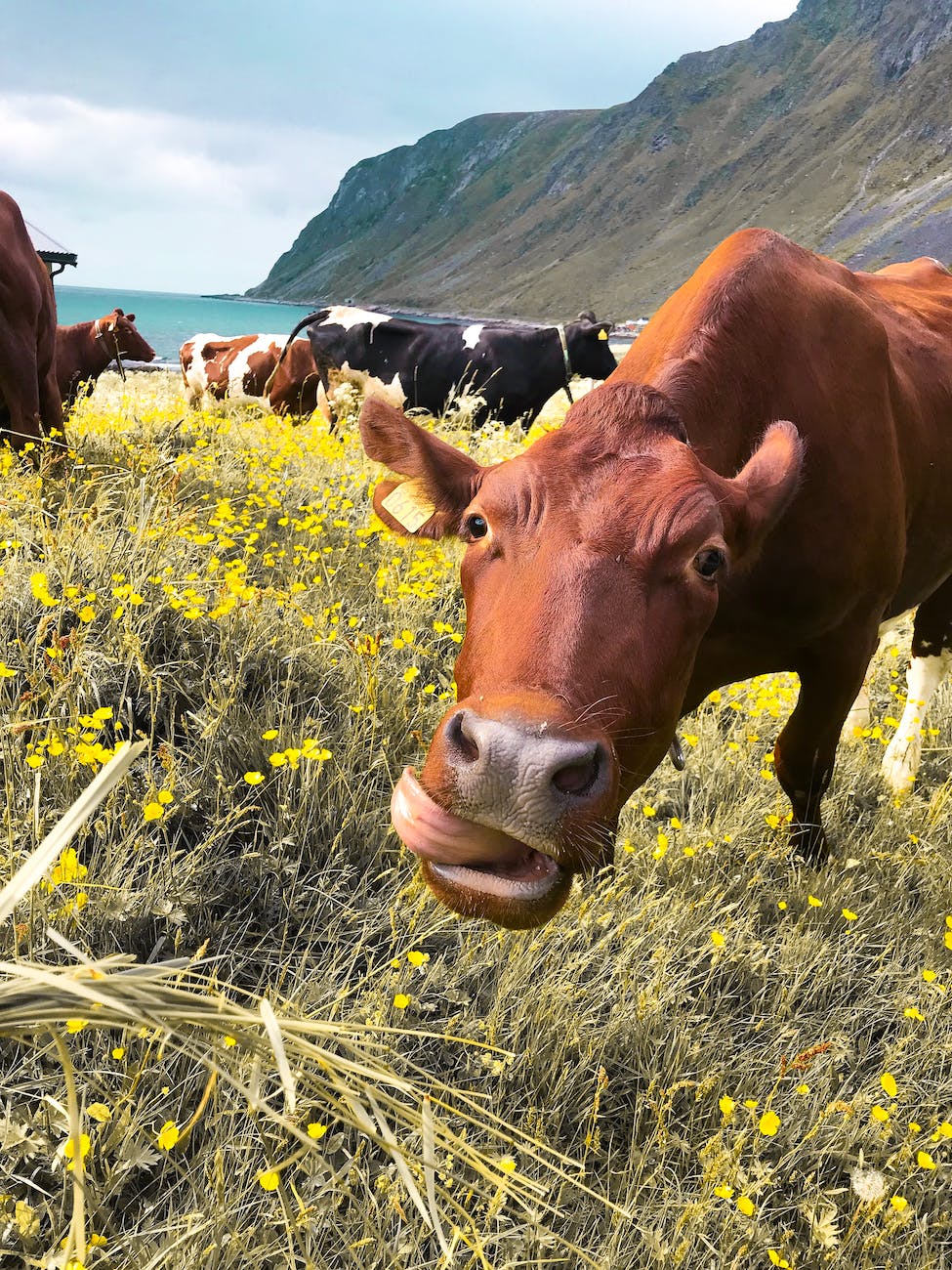
Cows are the most widely known and underappreciated ruminants I know.  With a four part stomach—the rumen, reticulum, omasum, and abomasum—cow manure is the best example of barrel turned compost on four legs. The first compartment of a cow’s stomach, the rumen, is the size of a barrel.  It can hold up to 40 gallons of material and 25-30 gallons of salt-filled saliva are sent down there every day to balance the rumen’s pH.  Just as in a compost pile, the smaller the fiber the more completely and efficiently it composts. So, what goes into the rumen is often sent back up for further chewing–for rumination.

Let me take a guess here. Perhaps the bovines ruminate on their bacterial partners, on how their partnership came to be.

Cows eat raw grass but, ultimately, the grass isn’t meant for them. It’s feeding the microbes that live just down the tracheal street. Those toothless wonders need pre-chewed grass, more surface area, mastication, before they can get to work. On the forest floor, beetles and worms do the work of pre-chewment. In a stomach, the organic material arrives pre-chewed, opening the way for them to extract all kinds of nutrients. Some they give to the cow, but a lot of it they keep for themselves, to give them energy and to make protein for their bodies. The microbes living inside the cow turn nitrogen stored in plants into protein. The cow is just there to provide them food and a warm place to live.

https://lallemandanimalnutrition.com/en/asia/whats-new/ruminant-microbiota-insight-part-1-meet-the-microbes/

Alchemists!

If you have been wondering if they exist, wonder no more, they reside in the rumen of ruminants. Ruminating on plant-filled sunshine. They will double in number every hour, and after a long life of just a few weeks, the microbes are washed away into the cow’s intestines to be food for the cow. Seventy five percent of all of a cow’s protein content comes from the spent bodies of ancient microbes.

McDonald’s (the hamburger patty and the cheese), that charcuterie board at the winery (the cheese and the wine), the Greek yogurt for breakfast, all of these made possible by ancient microbes living out their lives inside cows.

Human stomachs don’t have the ability to turn nitrogen into protein, but we rely on a similar microbial partnership. Just a thimble-full of large intestine fluids contains up to ten trillion microbes. Without them, we would be unable to make K and B vitamins. And even our own humanure is a precious resource[1].  When handled properly and with care, we can compost our own waste to use on trees, shrubs, lawns, and even agricultural crops, closing our nutrient cycle and saving millions of gallons of water by not flushing this resource down the toilet.

Our bodies have grown from the soil as much as our food has, and the microbes that make nutrients and proteins available to plants and cows and us are also waiting for us to give them our leftovers in a relationship of reciprocity. They do not care if what we give them is moldy or halfway chewed. They have no preference for a month-old piece of dried macaroni or a week old, uneaten scrap of a tostada. They only need the right conditions to break it down—the conditions found in a cow’s rumen, our own digestive tract, and the forest floor. Compost piles are a kind of external, symbiotic, second stomach in the backyard. The same conditions that we create in our compost piles—a warm, moist, aerated mass of carbohydrates and proteins large enough to house bacteria and fungus, undisturbed for a while so they can do their alchemist’s work–breaking down our leftover food into exactly what the soil needs to grow more food. Humus.

When we add compost back to the soil, its pulse quickens. What were once food scraps have transformed into a plant root buffet, the positive and negative charges that electrify the ground, begin to stir, poised, then grow, organize, coalesce, take form, take root, reach for the sunshine to be plucked by teeth or fingers or the header of a combine, harvested and reformed into food again.

We make soil food. Soils make we food.  We feed each other.

[1] Jenkins, Joseph.  Humanure Handbook: A Guide to Composting Human Manure.  1999.  Joseph Jenkins, Inc.: Grove City, PA.